

ICH Guideline Comparison Tool
Select First Guideline
Select Second Guideline
Guideline Comparison
Compare two guidelines| Comparison Aspect | Guideline 1 | Guideline 2 |
|---|---|---|
| Primary Purpose | ||
| Scope of Application | ||
| Key Requirements | ||
| Impact on Development Time | ||
| Countries Following |
Every time you pick up a prescription, whether it’s a simple antibiotic or a life-saving cancer drug, there’s a hidden global system working behind the scenes to make sure it’s safe, effective, and consistent - no matter where you live. That system is the ICH guidelines. Created in 1990 and formalized as a legal entity in 2015, the International Council for Harmonisation of Technical Requirements for Pharmaceuticals for Human Use brings together regulators and drugmakers from the U.S., Europe, Japan, and now over 30 countries to agree on one set of science-based rules. No more conflicting testing standards. No more redundant clinical trials. Just one clear path to getting safe medicines to patients faster.
Why ICH Guidelines Matter for Everyday Patients
Think about what happens when a new drug is developed. In the past, a company might run separate clinical trials in the U.S., Europe, and Japan - each with different paperwork, different safety thresholds, and different data formats. That meant delays. Higher costs. And sometimes, patients in one country got access years before others. ICH changed that. By standardizing how safety, quality, and effectiveness are measured, the same data can be used across markets. That cuts years off approval times. It also reduces the need for duplicate animal testing. A 2023 FDA report estimated that harmonization through ICH has cut unnecessary animal testing by more than 30% in some therapeutic areas.For you, the patient, this means fewer delays in getting new treatments. It also means more consistent safety monitoring. If a side effect shows up in Japan, regulators in Australia or Canada can act on the same evidence, not wait for a separate study. This isn’t theoretical. When the ICH E6 guideline on Good Clinical Practice was adopted globally, it became the universal standard for how clinical trials are run - from informed consent forms to data recording. Today, every major clinical trial, whether in Sydney or Seoul, follows the same rules. That’s not luck. That’s ICH at work.
The Four Pillars of ICH: Quality, Safety, Efficacy, and Multidisciplinary
ICH doesn’t just make one rule. It’s built on four clear categories, each with its own set of detailed technical guidelines. These aren’t vague suggestions - they’re precise, science-backed standards that drug companies must follow to get approval.- Quality (Q): Covers how drugs are made, stored, and tested for purity. Think of it as the manufacturing playbook. ICH Q1, for example, tells companies exactly how to test how long a drug stays stable under different temperatures - critical for medicines shipped across continents.
- Safety (S): Focuses on identifying risks before a drug reaches patients. ICH S1, the carcinogenicity guideline, sets how long animal studies must run to detect cancer risks. ICH S7 and S9 define how to test for heart toxicity and immune system effects - things that can kill if missed.
- Efficacy (E): Ensures clinical trials actually prove a drug works. ICH E3 tells companies how to structure their final study reports. ICH E5 deals with ethnic differences - meaning a drug tested in Europe must still be proven safe and effective for Asian or African populations if it’s to be sold there.
- Multidisciplinary (M): Covers areas that cross all categories. The newest one, ICH M13A, released in June 2024, sets a single global standard for testing bioequivalence in common pills like ibuprofen or metformin. Before this, different countries had different rules. Now, a generic version made in India can be approved in the U.S. using the same data.
As of 2024, there are over 60 finalized ICH guidelines. Each one has gone through a five-step process: proposal, consensus among experts, regulatory review, public comment, and final adoption. That’s not fast. But it’s thorough. And that’s why regulators trust them.
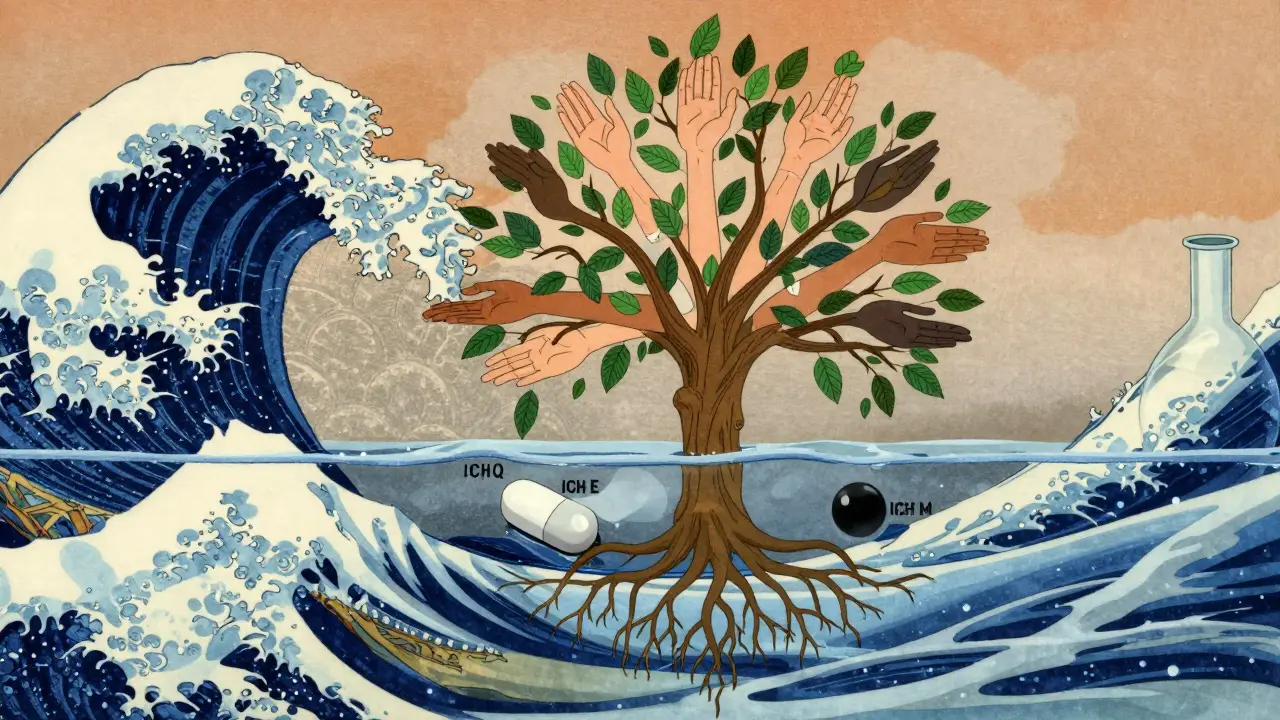
Real-World Impact: ICH M13A and the Rise of Real-World Evidence
The most recent update - ICH M13A - shows how ICH keeps up with changing needs. Before this guideline, generic drug makers had to run different bioequivalence studies depending on where they wanted to sell their product. Some countries required blood tests. Others used dissolution profiles. Some demanded multiple dosing regimens. ICH M13A unified all that. Now, one study, done once, can support approval in the U.S., EU, UK, Japan, Canada, and Australia.That’s a win for patients. It means cheaper generics hit the market faster. It’s also a win for the environment - fewer trials mean less chemical waste and fewer animals used in testing.
But ICH isn’t just fixing old problems. It’s tackling new ones. In June 2024, the ICH assembly approved a reflection paper on real-world evidence. This isn’t about lab tests or controlled trials. It’s about using data from electronic health records, insurance claims, and even wearable devices to understand how drugs perform in real life. For example, if a diabetes drug works well in clinical trials but causes unexpected drops in blood sugar in older patients outside the trial, real-world data can catch that. ICH is now creating a common language for how to collect, analyze, and report this data - so regulators worldwide can use it to make better decisions.
Who Follows ICH? The Global Network Behind the Rules
ICH started with the U.S., EU, and Japan. But today, it’s global. The UK became a full member in May 2022, right after Brexit. Canada, Australia, Singapore, South Korea, and Switzerland are all full participants. Even countries like Brazil and China, while not full members, align their national rules with ICH standards to make it easier for foreign drug companies to enter their markets.The U.S. Food and Drug Administration (FDA) doesn’t just recommend ICH guidelines - it enforces them. Every ICH guideline becomes an official FDA guidance document. If a company doesn’t follow ICH E6 in a U.S. clinical trial, the FDA can reject the entire application. The European Medicines Agency does the same. In Australia, the Therapeutic Goods Administration (TGA) explicitly references ICH guidelines in its approval checklist.
Why do companies care? Because compliance isn’t optional. If you want to sell a drug in the U.S., you must follow ICH. If you want to sell in Europe, you must follow ICH. There’s no shortcut. That’s why every major pharmaceutical company - from Pfizer to Novartis - trains its entire R&D team on ICH standards. It’s not a suggestion. It’s the baseline.

What Happens When ICH Guidelines Change?
Guidelines aren’t set in stone. They evolve. Take ICH E3, which governs how clinical study reports are written. In 2023, the FDA published a Q&A document clarifying how to report subgroup analyses - something that had become confusing as more trials started using complex data models. That’s the ICH Q&A Procedure in action: a fast, official way to fix misunderstandings without rewriting the whole guideline.Revisions happen too. ICH S1, the carcinogenicity guideline, was updated in 2021 to reduce the number of animals used in long-term cancer studies, based on new scientific evidence. The process is slow - sometimes taking years - but that’s by design. Change needs consensus. It needs data. And it needs time for regulators and industry to adapt.
But delays do happen. New therapies like gene editing or AI-driven drug discovery don’t always fit neatly into old ICH categories. That’s the next challenge. The organization is already working on new frameworks for cell and gene therapies, but progress is cautious. Regulators won’t rush. Patients won’t want them to.
What’s Missing? The Limits of Harmonization
ICH isn’t perfect. It’s voluntary. A country can choose not to adopt a guideline. Some low-income nations lack the labs or staff to implement complex ICH standards. That’s why the World Health Organization (WHO) and the International Pharmaceutical Regulators Programme (IPRP) work alongside ICH to help build capacity in developing countries.Also, ICH doesn’t control pricing. It doesn’t decide which drugs get made. It doesn’t handle access or equity. Its job is safety and science. That’s a strength - it keeps politics out of technical rules. But it’s also a limitation. A drug can meet every ICH standard and still be too expensive for most people. That’s a policy issue, not a regulatory one.
Still, for what it does, ICH works. It’s the most successful example of global regulatory cooperation in history. And it’s growing. With every new guideline, every country that joins, every piece of real-world data it starts to use, ICH makes the global drug system safer - one consistent standard at a time.
What are ICH guidelines and why are they important?
ICH guidelines are globally agreed-upon scientific standards for developing and testing medicines. Created by regulators and drugmakers from the U.S., EU, Japan, and other countries, they ensure that drugs are safe, effective, and made to the same high quality no matter where they’re produced or sold. This reduces duplication of testing, speeds up approvals, and helps patients get new treatments faster.
Which countries follow ICH guidelines?
The original members are the U.S. (FDA), European Union (EMA), and Japan (PMDA). Today, full members include Canada, Australia, Switzerland, South Korea, Singapore, and the UK. Many other countries - including Brazil, China, India, and Mexico - align their national regulations with ICH standards to make it easier for international drug companies to enter their markets. Even if not a formal member, most major drug markets follow ICH.
Are ICH guidelines legally binding?
Not directly - ICH itself doesn’t have enforcement power. But once a country’s regulatory agency adopts a guideline (like the FDA or EMA), it becomes mandatory. In the U.S., every ICH guideline is published as an official FDA guidance document. Companies that don’t follow them risk having their drug applications rejected. So while voluntary in theory, in practice, compliance is required to sell medicines in major markets.
How often are ICH guidelines updated?
Guidelines are updated as science evolves. The ICH has four procedures for changes: Formal (for new guidelines), Revision (for major updates), Q&A (for clarifications), and Maintenance (for minor edits). Revisions can take years because they require global consensus. For example, ICH S1 was updated in 2021 to reduce animal testing. The most recent update, ICH M13A on bioequivalence, was implemented in June 2024.
What’s the difference between ICH E6 and ICH M13A?
ICH E6 is the foundation for how clinical trials are conducted - covering ethics, data integrity, and patient safety. It applies to all drug trials. ICH M13A is much more specific: it sets a single global standard for testing whether generic pills (like aspirin or metformin) work the same as the brand-name version. E6 is about process. M13A is about a single type of test for a specific kind of drug.
How does ICH help reduce animal testing?
By harmonizing safety tests, ICH eliminates the need to repeat the same animal studies in different countries. For example, ICH S1 and S7 guidelines now allow companies to use the same toxicology data for approval in the U.S., EU, and Japan. Updates to ICH S1 in 2021 also reduced the number of animals needed for long-term cancer studies by using modern statistical methods. This has cut unnecessary animal testing by over 30% in some areas, according to the FDA.




Finally, someone explains why my generic metformin works the same in Toronto as it does in Tokyo. I used to think it was magic. Turns out it’s just decades of quiet, boring, brilliant collaboration between regulators who actually care about patients over profits. This is the invisible infrastructure that keeps us alive.
Let’s be real - this whole ICH thing is just Big Pharma’s way of locking out smaller competitors under the guise of ‘harmonization.’ They’ve turned a system meant to protect patients into a compliance minefield where only corporations with legal teams the size of small countries can survive. The ‘one-size-fits-all’ approach ignores biological diversity, cultural differences in drug metabolism, and the fact that not every population reacts the same to a compound. They call it science. I call it corporate monoculture dressed in lab coats.
Wait… so you’re telling me the FDA, EMA, and PMDA - all controlled by the same shadowy pharmaceutical lobby - secretly agreed on ONE set of rules… and now you’re acting like this is a good thing? Who funded the ICH? Who wrote the original drafts? Who gets to decide what ‘science-based’ even means? There’s a reason they call it the ‘International Council for Harmonisation of Technical Requirements for Pharmaceuticals for Human Use’ - not ‘for Patients’ or ‘for Transparency.’ It’s a cartel. And now they’re using ‘real-world data’ to spy on us through our Fitbits and EHRs. Next thing you know, your insulin usage will be flagged as ‘non-compliant’ and your insurance will cancel you. They’re not making drugs safer - they’re making you easier to control.
I just want to say thank you for writing this. As someone whose kid got access to a life-saving gene therapy because the trial data was accepted globally, I’ve seen firsthand how this works. No politics. No delays. Just science moving fast enough to save lives. It’s not perfect, but it’s the best thing we’ve got. Keep pushing for more inclusion, more transparency - but don’t throw out the system because it’s not ideal. It’s the only thing keeping us from going back to the 1980s, where a child in Brazil might die because their country didn’t have the budget to run its own trial for a drug already proven safe elsewhere.
So let me get this straight - we’re letting some international committee write our drug rules now? Who elected them? We didn’t vote on this. And now they’re telling us how to test ibuprofen? What’s next? ICH deciding how many carbs we can eat? This isn’t science - it’s globalist overreach. The FDA used to be American. Now it’s just a branch office for Brussels and Tokyo. And don’t even get me started on how they’re using ‘real-world data’ to track our health without consent. This is the slippery slope to a medical dictatorship. Wake up, people.
You think this is impressive? In India we’ve been doing this for decades with generic manufacturing - cutting costs, bypassing redundancies, saving lives. ICH just formalized what we were already doing efficiently. The real story isn’t the guidelines - it’s how Western pharma still acts like they invented medicine. I’ve seen labs in Mumbai produce bioequivalent drugs that pass ICH M13A with flying colors, then get rejected by the FDA because their packaging doesn’t match some aesthetic standard. It’s not about safety - it’s about control. And the fact that you’re praising ICH like it’s a gift from the gods shows how little you understand global pharma power dynamics.
Wow so much text for something that’s basically just a bunch of bureaucrats making sure Big Pharma doesn’t have to do extra work. I mean, I get it - less testing means faster drugs. But who’s actually benefiting here? The patients? Or the CEOs who just got another billion in revenue because they didn’t have to run five different trials? And why are we celebrating a system that makes it harder for small innovators to compete? Also, real-world data? That’s just corporate surveillance with a medical label. I’m tired of being told to trust the system when the system is designed to protect the rich.
It’s beautiful, isn’t it? The quiet, unspoken covenant between nations - not of flags or borders, but of science. For once, humanity put aside nationalism and said: ‘Let us not let our children die because of paperwork.’ This isn’t policy. This is love. Silent, stubborn, bureaucratic love. It doesn’t scream. It doesn’t march. It just… works. And in a world that’s falling apart at the seams, this - this tiny, unsexy, perfectly calibrated engine of cooperation - is the closest thing we have to hope. So yes, let’s keep refining it. Let’s expand it. Let’s make it include the forgotten corners of the world. Because if we can agree on how to test a pill… maybe we can learn to agree on how to live.