

When a batch of medicine is released to patients, no one should be asking, "Was this approved because it met standards-or because the factory was behind schedule?" That’s the exact risk independent quality assurance units (QUs) exist to prevent.
What Is a Quality Assurance Unit?
A Quality Assurance Unit isn’t just another department in a factory. It’s a legally required, independent body with the power to stop production, reject batches, and override management decisions-all to protect patient safety. In pharmaceuticals, nuclear facilities, and other high-risk industries, the QU is the last line of defense between a flawed product and the public.It’s not about checking labels or doing random inspections. The QU’s job is systemic: review every procedure, audit every record, and ensure nothing leaves the facility unless it meets strict, documented standards. Under FDA regulations (21 CFR 211.22), the QU must have the authority to approve or reject all components, packaging, in-process materials, and finished products. No exceptions.
What makes it different from quality control? Quality control tests samples. Quality assurance ensures the whole system works. One checks the product. The other checks the process that makes the product.
Why Independence Isn’t Optional
Imagine a production manager who’s under pressure to hit monthly targets. They’ve got a batch that’s slightly off-spec-but it’s 98% good. Should they release it? If the quality team reports to that same manager, the answer might be yes. That’s not a failure of judgment-it’s a failure of structure.The FDA made it clear in 2006: quality assurance units must be independent. Not "somewhat" independent. Not "ideally" independent. Fully independent. That means they can’t report to production, operations, or any department with a financial stake in output speed.
Why? Because when quality decisions are tied to production goals, corners get cut. Data gets tweaked. Deviations get buried. According to FDA inspection data from 2024, 63% of warning letters for data integrity violations came from facilities where quality and production were not properly separated.
The nuclear industry learned this the hard way after Three Mile Island. Independent oversight isn’t a luxury-it’s the only thing that stops small errors from becoming catastrophic. The IAEA found that organizations with true QU independence had 37% fewer critical compliance failures during inspections.
How Independence Is Structured
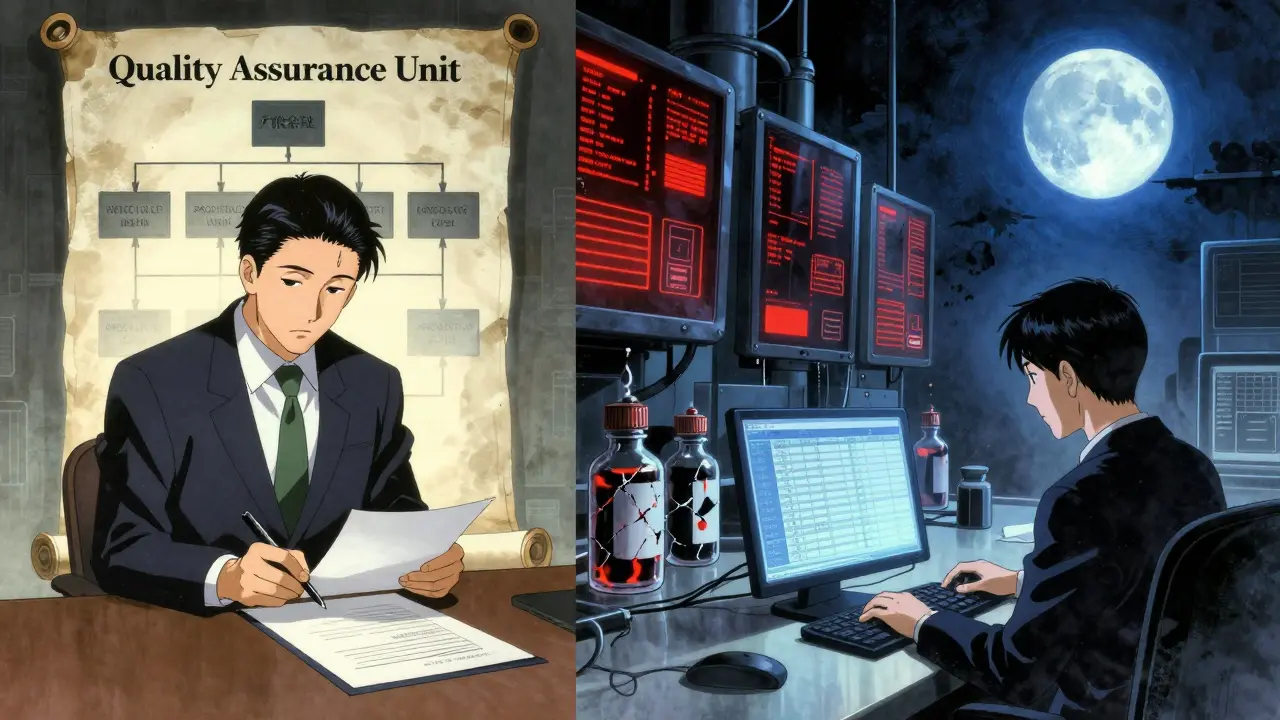
True independence isn’t just a policy-it’s built into the org chart.- The QU reports directly to the CEO, CFO, or Board of Directors-not to the plant manager.
- They have their own budget, separate from production.
- They can halt production without asking permission.
- They audit their own department regularly to ensure they’re not becoming complacent.
Regulations like FDA’s GMP and EMA’s EudraLex Annex 1 are crystal clear: quality units cannot be organizationally subordinate to production under any circumstances. Even in small companies with 20 employees, this rule applies. The only exception? A single person handling both roles-but only if another qualified, non-production person reviews their work periodically.
Documentation matters. 95% of FDA warning letters cite inadequate documentation of QU authority. If you can’t show a chart proving the QU answers to the top of the company, you’re not compliant.
What Happens When Independence Fails
There’s a pattern in every warning letter, every recall, every scandal.- Production pushes back on quality holds.
- Quality staff are pressured to "sign off" on questionable batches.
- QU staff are told, "We’ll fix it next time."
One Reddit user from a mid-sized pharma company shared their experience: their production manager was also acting as QA manager during a restructuring. Within three months, two critical deviations went uninvestigated before batch release. The FDA issued a warning letter. The company lost its certification.
Smaller companies are especially vulnerable. FDA data shows 42% of warning letters to facilities under 50 employees cite QU independence failures. Why? They can’t afford a full team. But cutting corners here doesn’t save money-it creates liability.
Some companies try to solve this by hiring third-party oversight services. It’s growing fast-14.2% annual growth, according to Pharmaceutical Technology. For small businesses, it’s often the only way to stay compliant without adding full-time staff.
Performance Gains from Real Independence
This isn’t just about avoiding fines. Independent QUs make companies better.- Organizations with true QU independence resolve critical quality deviations 28% faster than those with integrated teams.
- First-time inspection success rates are 31% higher in companies with independent QUs, per ISPE’s 2025 benchmarking study.
- Facilities with QU-to-production staff ratios below 1:15 see 3.2 times more repeat deviations.
At Eli Lilly, they didn’t merge departments-they created "quality ambassadors." Manufacturing staff were trained by the QU to understand quality principles, but the QU retained full authority. The result? A 40% improvement in quality culture.
It’s not about making production angry. It’s about making production better. When people know quality isn’t negotiable, they design better processes from the start.

Challenges in the Digital Age
New technology is changing the game. AI-driven systems now make real-time decisions on product quality-adjusting temperature, flow rates, or mixing times without human input.That’s great for efficiency. But who’s overseeing the algorithm? If the AI is trained on historical data from a team that cut corners, it will repeat those mistakes.
The FDA’s January 2025 draft guidance on "Quality Unit Independence in Digital Manufacturing" warns that traditional org charts won’t cut it anymore. The independence principle must be built into the software-through algorithmic separation, audit trails, and automated flags that can’t be overridden by production staff.
It’s not about replacing humans. It’s about ensuring the system-human and digital-can’t be manipulated.
What You Need to Build a Compliant QU
If you’re setting up a QU-or auditing one-here’s what actually works:- Give the QU direct access to the CEO. No filters. No approvals needed.
- Document their authority in writing. Include a chart showing reporting lines.
- Ensure they can halt production without consulting anyone in manufacturing.
- Train them in GMP, statistical process control, and conflict resolution.
- Keep QU staff at 8-12% of total manufacturing headcount.
- Review their work annually with an external auditor.
It takes 6-9 months to embed this culture. Merck’s 2023 case study showed initial resistance from production leaders. But once they saw fewer recalls and faster inspections, the pushback faded.
Bottom Line
Quality assurance units aren’t a cost center. They’re a risk shield. Every time you compromise their independence, you’re betting patient safety against production speed. And history shows that bet always loses.Regulators aren’t going soft. FDA warning letters citing QU independence failures jumped from 29% in 2020 to 68% in 2024. The global market for quality assurance is projected to hit $22.1 billion by 2029-not because companies want to spend more, but because they have to.
If your QU doesn’t have real power, it doesn’t have real value. And if it doesn’t have real value, your patients are at risk.
Can a production manager also be the quality manager?
No-not in regulated industries like pharmaceuticals or nuclear. Even if one person holds both roles, a separate, qualified individual who has no involvement in production must periodically review their quality decisions. The FDA allows this only in "very limited circumstances," and it’s still risky. Most companies avoid it entirely to prevent compliance failures.
What happens if a quality unit can’t stop production?
If a quality unit lacks the authority to halt production, it’s not truly independent-and it’s not compliant. Regulatory agencies like the FDA and EMA consider this a critical failure. In practice, it leads to batch releases that shouldn’t happen, data integrity violations, and eventual warning letters or shutdowns. Patient safety is compromised the moment quality can’t override production pressure.
How small can a company be and still need an independent QU?
Every company manufacturing regulated products-no matter how small-must have an independent quality unit. The size doesn’t matter. The risk does. Small companies often use third-party oversight services or contract with a qualified external consultant to fulfill this role. The FDA has issued warning letters to facilities with fewer than 10 employees for failing to meet this requirement.
Do quality assurance units need to be certified?
The unit itself isn’t certified, but every member must be trained and qualified. In pharmaceuticals, all QU staff must have GMP training. Many have degrees in pharmacy, engineering, or quality systems. The FDA and EMA require documented proof of competency-not a certificate. What matters is their ability to interpret regulations, audit processes, and make objective decisions under pressure.
Is ISO 9001 enough for quality oversight?
No. ISO 9001 is a general quality management standard, but it doesn’t require independent oversight with authority to reject products. In regulated industries like pharmaceuticals, ISO 9001 is a baseline-not a replacement. You still need GMP compliance, which demands a fully independent quality unit with legal authority to halt production and reject batches.
What skills should a quality assurance professional have?
Beyond regulatory knowledge (GMP, FDA/EMA guidelines), top QU staff need statistical process control (78% of roles require it), audit experience, conflict resolution skills (65%), and the ability to write clear, defensible reports. On average, QU professionals have over 8 years of industry experience. They’re not just auditors-they’re risk managers who speak both production and regulation.


This is the kind of post that makes me want to hug my QA team. Seriously. They’re the ones holding the line while everyone else is racing to meet deadlines. I’ve seen what happens when they’re ignored. It’s not pretty.
Independence isn’t optional. It’s the law. If your QA unit reports to production, you’re already non-compliant. No excuses.
😭 I cried when I read the part about Three Mile Island. This isn’t paperwork. This is life or death. 🙏
Oh please. Another ‘quality warrior’ post. You think the FDA cares about your org chart? They care about the bottom line. If you’re not making product, you’re dead. QA is a cost center. Period.
I’ve worked in both big pharma and small biotech, and I can tell you - the companies that treat QA as a shield, not a barrier, are the ones thriving. They don’t just avoid warning letters; they attract top talent, retain customers, and sleep at night. The ROI isn’t in dollars saved - it’s in trust earned. When your patients know you’d rather shut down than ship a bad batch, they don’t just buy your product - they believe in your mission. That’s the real competitive advantage. And yeah, it takes time to build. But once you do, you won’t ever want to go back to the old way. Even the production folks eventually get it - when they see fewer recalls, fewer audits, fewer sleepless nights. It’s not about being ‘difficult.’ It’s about being dependable.
Ugh I just had a meeting where my boss said ‘we’ll fix it next time’ after a critical deviation… again. I’m so tired of being gaslit by management. They act like QA is the problem, not the solution. I’m not the enemy - I’m the only one who remembers we’re making medicine for people who can’t afford to be wrong. And now I’m thinking of quitting. Because what’s the point if no one listens?
Let’s be real - AI-driven QA systems are the future, but they’re only as good as the data they’re trained on. If your historical dataset includes 37% of batches that were ‘approved under pressure,’ your algorithm is just automating negligence. GMP 2.0 isn’t about org charts anymore - it’s about algorithmic integrity. Audit trails must be immutable. Override flags must require dual authentication from non-production roles. If you’re still using Excel logs for deviation tracking, you’re already behind. And yes, I’ve audited your system. You’re not compliant.
Why do we keep pretending this is about compliance? It’s about courage. Someone has to say no. And that someone gets called a buzzkill. But if you’re not willing to be the buzzkill, someone’s child will pay the price. I’m done being polite.
ISO 9001 is a nice start. But it doesn’t stop a production manager from overriding a QA hold. Only law and structure can do that.
What if independence isn’t the goal - but the symptom? What if the real question is: how do we design systems where quality emerges naturally from the process, not from fear of punishment? Maybe the answer isn’t more org charts - but more transparency, more feedback loops, more psychological safety. Maybe the QU is a bandage on a deeper wound.
Look. I used to think QA was the department that said no to everything. Then I worked at a place where they actually listened to QA. We redesigned the entire mixing process because they flagged a 0.3% variance that nobody else cared about. Six months later, our yield went up 18%, and our inspection pass rate hit 99%. QA didn’t slow us down - they made us better. And now I train new hires: ‘If you don’t respect QA, you don’t respect the product.’ Simple. No drama. Just truth.
Why are we even talking about this? In the US, we have the FDA. In Europe, EMA. In China, NMPA. They all say the same thing: QA must be independent. If you’re in a country without regulation, maybe you shouldn’t be making medicine at all. This isn’t a debate. It’s a basic requirement. Stop making it complicated.
For small companies: hire a part-time QA consultant. It’s cheaper than a recall. Cheaper than a shutdown. Cheaper than your reputation. And yes - they can be external. The FDA doesn’t care if they’re on payroll - they care if they have authority. I’ve helped five startups do this. All survived their first audit. All are still in business. You don’t need a team. You need a voice. And that voice doesn’t have to be full-time.
Oh, so now we’re blaming production for wanting to make money? How quaint. Let’s not pretend QA is some noble knight. They’re just another department with power. The real problem? Management lets them have it. And then wonders why things get slow. Maybe the answer isn’t more independence - maybe it’s less bureaucracy. Maybe we need to trust people instead of locking them in org charts.