

Medical Alert Bracelet Checker
Check Your Medical Alert Bracelet Information
This tool checks if your medical alert bracelet contains the critical information that can save your life in emergencies. Enter your medical details below.
Why This Matters
In emergencies, 37% of ER errors involve medications. Your bracelet could be the difference between life and death.
Every year, thousands of people end up in emergency rooms because of medication errors - mistakes that could have been avoided with a simple piece of jewelry on their wrist. A medical alert bracelet isn’t just a fashion accessory. It’s a lifeline. When you’re unconscious, confused, or unable to speak, that bracelet becomes your voice. And in drug safety emergencies, that voice can mean the difference between life and death.
Why Medical Alert Bracelets Exist
The first medical alert bracelet was created in 1956 by the MedicAlert Foundation. Back then, it was a simple metal band engraved with a few words: Diabetic - Insulin Dependent. Today, it’s a global system trusted by first responders in over 90 countries. Why? Because emergencies don’t wait. When someone collapses, paramedics don’t have time to dig through a wallet or call family. They check the wrists and neck - that’s standard protocol, confirmed by the American College of Emergency Physicians.Here’s the hard truth: 37% of all emergency room errors involve medications, according to a 2022 study in the Journal of Emergency Medicine. That’s not a small number. That’s one in three patients getting the wrong drug, the wrong dose, or a drug that could kill them because their medical history wasn’t known.
Medical alert bracelets fix that gap. They give responders the critical info they need in the first 60 seconds - before they even start an IV.
What Information Saves Lives
Not every detail matters. First responders don’t need your entire prescription list. They need the stuff that changes how they treat you right now.Here’s what belongs on your bracelet, in order of priority:
- Drug allergies - Especially penicillin, latex, sulfa drugs, and NSAIDs like ibuprofen. Penicillin allergies affect 10% of Americans. A single dose can trigger anaphylaxis - a reaction that kills in minutes.
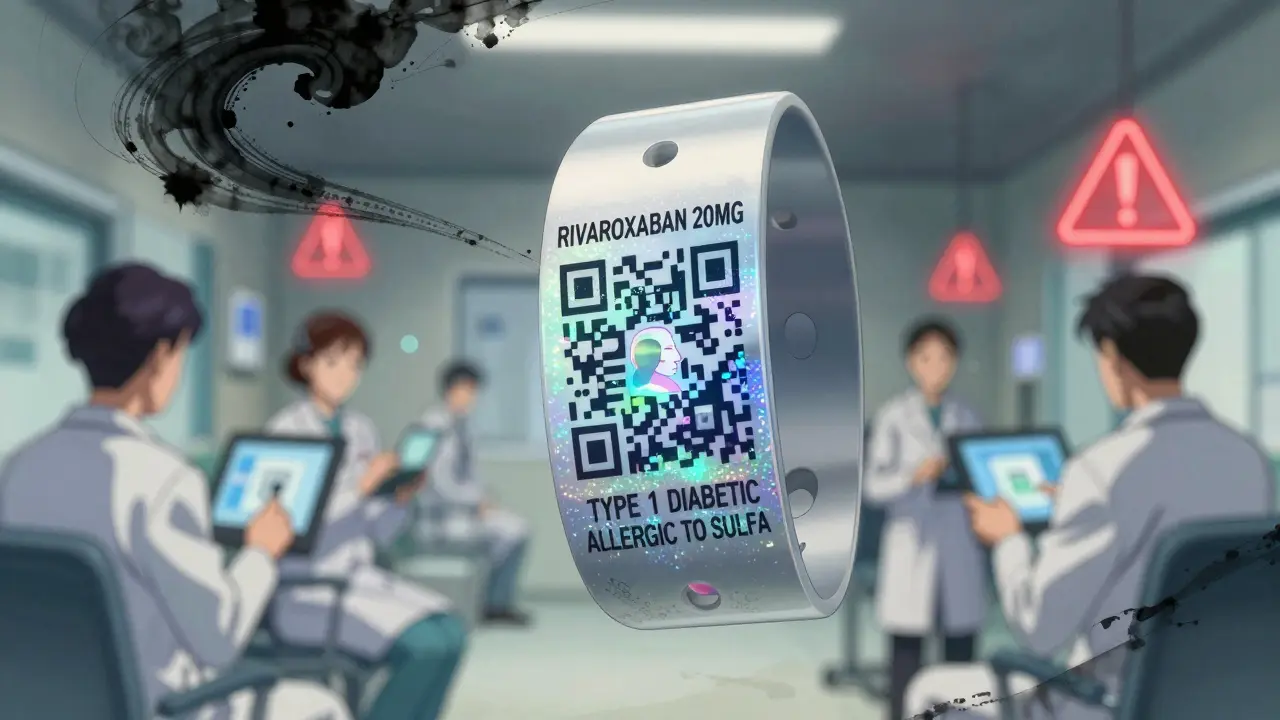
- Current medications that change emergency care - Blood thinners like warfarin, rivaroxaban, or apixaban. These affect 2.9 million Americans. If you’re bleeding out after a fall, giving you a clotting agent could be fatal. Your bracelet tells them: DO NOT ADMINISTER ANTICOAGULANTS.
- Chronic conditions with specific treatment needs - Type 1 vs. Type 2 diabetes. Insulin dependence. Severe asthma. Pacemaker. These determine whether you get glucose, insulin, epinephrine, or a defibrillator.
One user on Reddit, ‘AllergicAmy’, shared her story: during an appendectomy, the ER team was about to give her penicillin. Her bracelet said ANAPHYLACTIC TO PENICILLIN. The nurse stopped. She lived. That’s not luck. That’s a bracelet doing its job.
Traditional vs. QR Code Bracelets
You have two main options: engraved metal or digital QR code.Traditional metal bracelets are simple. They cost $49.99 and up. But space is limited - usually 3 to 5 lines of text. That’s fine if you have one allergy and one critical med. But if you’re on five medications, have two allergies, and have kidney disease? You’ll have to pick. Many users complain: ‘My bracelet just says “ON BLOOD THINNERS” - but not which one. They still had to run tests.’ That’s dangerous. Warfarin and apixaban need different reversal agents. Vague info isn’t safe.
QR code bracelets (like those from MedicAlert Foundation since 2018) solve this. Scan the code, and you get a full digital profile: every medication, dosage, pharmacy, doctor, allergies, and even advance directives. These cost $69.99 plus a $59.99 annual fee to keep your profile updated. But here’s the kicker: 68% of all medical bracelet orders now include medication details, and 42% of those are for blood thinners. People are catching on.
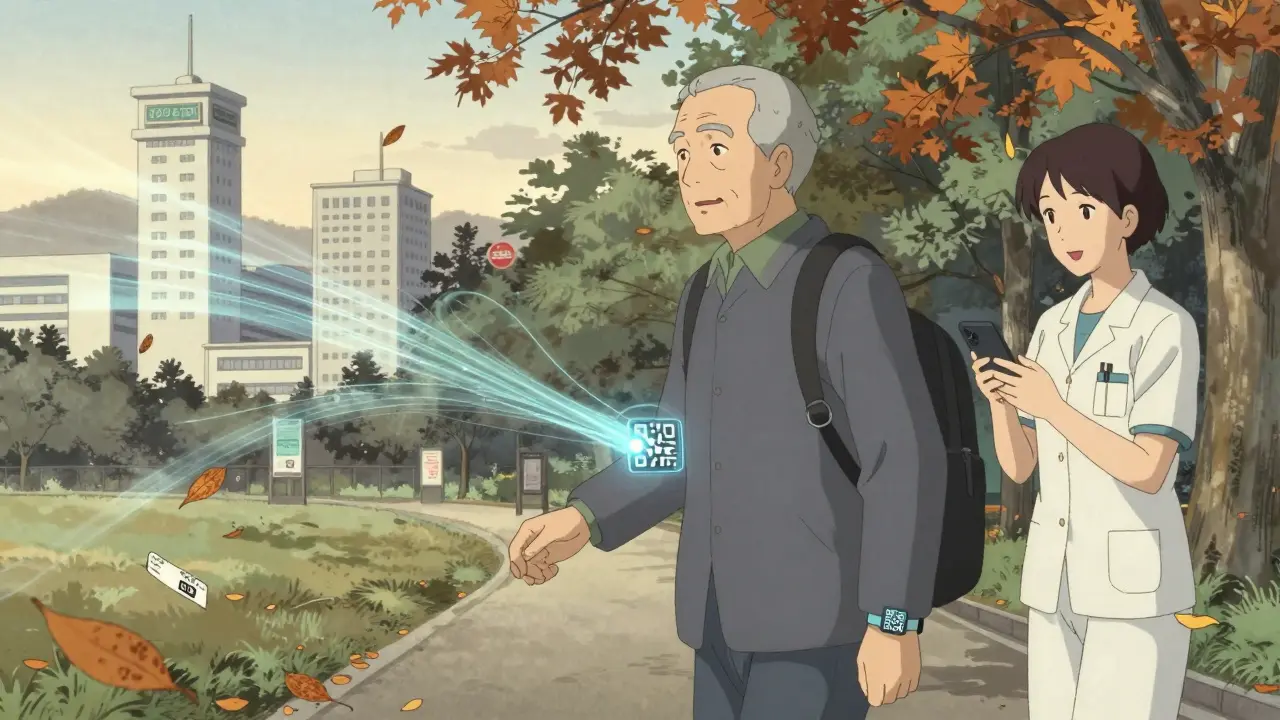
And it’s not just about storage. Newer systems like MedicAlert’s SmartProfile (launched Jan 2024) sync with pharmacy databases. If your doctor changes your warfarin to rivaroxaban, your bracelet updates automatically. No more forgetting.
Who Needs One the Most
You don’t have to be elderly or frail to need one. Here’s who benefits most:- People on blood thinners - 41% of warfarin users wear one.
- Those with severe allergies - 33% of people with anaphylactic allergies use them.
- Diabetics - 28% of insulin-dependent users wear IDs.
- People with rare conditions like myasthenia gravis or epilepsy that require specific meds.
- Anyone over 65 taking five or more medications - polypharmacy is a silent killer.
And it’s not just for you. If you care for a parent, sibling, or partner with complex meds, get them one. The National Council on Aging found 73% of medical ID-related emergencies happen when the person is away from home - shopping, traveling, visiting family. You can’t be there every second. But a bracelet can.
What Goes Wrong - And How to Fix It
The biggest problem isn’t the bracelet. It’s outdated info.According to the American Pharmacists Association, 35% of users never update their bracelets after changing medications. That’s terrifying. Imagine wearing a bracelet that says WARFARIN 5MG - but you’ve been on apixaban 20mg for six months. First responders might give you the wrong reversal drug. You could bleed internally.
Here’s how to avoid that:
- Set a calendar reminder every time your meds change - even if it’s a new antibiotic.
- If you use a QR code bracelet, enable auto-sync with your pharmacy. Most major providers offer this now.
- Review your profile every 6 months. Ask your pharmacist to help you clean it up.
Another issue? Quality of service. MedicAlert Foundation scores 4.3/5 in customer support. Smaller brands? Average 3.1/5. You’re paying for safety. Don’t skimp on support.
What Doctors and First Responders Say
Dr. Richard Bradley, an emergency physician and ACEP spokesperson, says: ‘Medical ID bracelets reduce medication error rates by 28% in unconscious patients.’ That’s not a guess. It’s data from ER logs.And it works. MobileHelp’s 2023 study tracked 142 cases where bracelets prevented fatal drug interactions - mostly involving blood thinners and emergency surgery.
But here’s the gap: only 14% of EMTs get formal training on interpreting complex medication info on IDs. That’s why the FDA launched its Medical ID Modernization Initiative in 2023 - to standardize how info is written. Now, they’re pushing for NDC drug codes to be included. That means even if a responder doesn’t know what “Eliquis” is, they can look up the code and find the exact drug.
Is It Worth It?
Costs range from $50 for a basic bracelet to $300 for a smart system with monitoring. Monthly fees for connected services start at $29.95. But compare that to the cost of a single ER visit for a preventable reaction - often $10,000 or more.And it’s not just money. It’s peace of mind. A 2023 survey by the ID Band Company found 78% of blood thinner users felt ‘extreme peace of mind’ knowing their bracelet would speak for them. 31% had already had an incident where it changed treatment.
One woman on Trustpilot wrote: ‘I’ve worn mine for 12 years. I’ve had two falls. Both times, the paramedics said, ‘We saw your bracelet and knew exactly what to do.’ I’m alive because of it.’
What’s Next?
The future is integration. Epic and Cerner - the two biggest hospital EHR systems - are building direct links to medical ID profiles. When your doctor changes your meds, your bracelet updates. No manual entry. No forgotten updates.The National Institutes of Health predicts a 21% rise in adoption among high-risk users by 2027. Hospitals are already required by the 2022 CARES Act to check for medical IDs during intake. It’s becoming standard.
Medical alert bracelets are no longer a niche tool. They’re a core part of drug safety. In a world where medication errors kill more people than car accidents, this isn’t optional. It’s essential.
Do medical alert bracelets really work in emergencies?
Yes. First responders are trained to check wrists and necks during emergencies. In 89% of cases where a bracelet is present, responders use the info correctly, according to GoodRx. Studies show they reduce medication errors by 28% in unconscious patients. Real-world cases prove they prevent fatal reactions - especially with allergies and blood thinners.
What should I put on my medical alert bracelet?
Prioritize: 1) Drug allergies (name the drug, e.g., ‘ALLERGIC TO PENICILLIN’), 2) Critical medications like blood thinners (e.g., ‘ON WARFARIN’), 3) Chronic conditions requiring emergency protocols (e.g., ‘TYPE 1 DIABETIC, INSULIN DEPENDENT’). Avoid vague terms like ‘on meds’ - be specific. If space is tight, use a QR code bracelet to store full details.
Are QR code bracelets better than engraved ones?
For complex medication regimens, yes. Engraved bracelets are limited to 3-5 lines of text. QR code versions store your full list of drugs, dosages, allergies, doctors, and even advance directives. They’re ideal if you take five or more medications, have multiple allergies, or use blood thinners. The downside: they require a phone to scan and an annual fee to maintain the profile.
How often should I update my medical alert bracelet?
Every time your medications change - even if it’s a new antibiotic or a dosage adjustment. A 2024 study found 35% of users never update their bracelets, creating dangerous misinformation. Set a calendar reminder every 6 months, or use a QR bracelet with auto-sync to your pharmacy’s database. Outdated info can be as dangerous as no info.
Can I wear a medical alert bracelet if I’m young and healthy?
Absolutely. You don’t have to be elderly to need one. If you’re on blood thinners, have severe allergies, take insulin, or have a condition like epilepsy or myasthenia gravis, you’re at risk - no matter your age. Emergency responders don’t ask your age. They look for the bracelet. If you’re on a drug that could cause a life-threatening reaction if misused, wear one.



My dad’s been wearing his MedicAlert for 12 years. He’s on warfarin, has a pacemaker, and is allergic to sulfa. Last year, he fell at the grocery store. Paramedics saw the bracelet, checked his meds, and skipped the clotting agents. He walked out the same night. This isn’t hype-it’s hardware for your body.
Okay but like… why are we still using metal? 😅 I got the QR one last year and my whole med history is just a scan away. My pharmacist updates it automatically. My mom still has the old-school one that says ‘ON BLOOD THINNERS’-like, cool, but which one? I’m pretty sure that’s just asking for trouble.
There’s a semiotic layer here that’s rarely acknowledged: the medical alert bracelet is the last vestige of analog bio-data persistence in an age of ephemeral digital records. It’s not just a tool-it’s a covenant between the body and the emergency system. The QR code represents a transition from static inscription to dynamic ontology. But here’s the paradox: the more sophisticated the tech, the more fragile the chain of trust. If the server goes down, the profile vanishes. The engraved metal? It doesn’t need Wi-Fi. It just needs a pulse.
Of course people don’t update theirs. They’re lazy. I saw someone wearing a bracelet that said ‘ALLERGIC TO PENICILLIN’… but she was on apixaban, rivaroxaban, and lisinopril. And she didn’t even know what her INR was. How is this not a public health scandal? You’re not just risking your life-you’re risking the ER’s time, the nurses’ sanity, and taxpayer money. Wake up.
My cousin’s a paramedic in Chicago. He says the weirdest thing he sees? People with 12 prescriptions wearing a bracelet that says ‘DIABETIC.’ Like… bro, you’re on metformin, glimepiride, and insulin glargine-your bracelet should scream that. Or better yet, scan the damn QR. I got mine from MedicAlert last year. My profile’s got my neurologist’s number, my pharmacy, my advance directive, and even my dog’s name. (He’s my emotional support golden retriever. Don’t judge.)
Just a heads-up: the FDA’s new NDC code initiative? It’s not mandatory yet. And most QR bracelets don’t even support it. If you’re thinking of buying one, check if the vendor’s profile supports NDCs. Otherwise you’re just paying for a fancy URL that doesn’t help anyone in a code blue.
This is beautiful. In Nigeria, we don’t have this culture yet. But I just bought one for my aunt who’s on warfarin. She doesn’t even have a phone, so I got the engraved one. I wrote it in English and Yoruba. Hope it saves her. 🙏
Oh wow. So now we’re telling people to spend $300 on a bracelet because doctors can’t read a chart? 😒 Let me guess-next we’ll be paying for a tattoo that says ‘DO NOT RESUSCITATE’ in glitter font. This is capitalism turning survival into a subscription service. Get a phone. Carry a card. Or better yet-train the damn EMTs.
I’ve worn mine since 2018. It’s engraved with: ‘ALLERGIC TO PENICILLIN & NSAIDS | ON RIVAROXABAN 20MG | TYPE 1 DIABETIC’. I update it every six months. I also have the QR code linked to my EHR. I’m not ‘extra’-I’m just not dying because someone misread my handwriting.
People who don’t wear these are basically gambling with their lives. And not even a fun gamble-like, the kind where you lose your car. You’re gambling with your organs. Your brain. Your kids’ future. If you’re on blood thinners and you don’t have one? You’re not just irresponsible-you’re a liability to the entire medical system. Get one. Now. Or don’t come crying when they give you a clotting agent and you bleed out in the hallway.
QR bracelets are useless if your phone dies. Also, ‘auto-sync’? Lol. My pharmacy’s system crashed last month. My bracelet still said warfarin. I’m just gonna stick with metal. Simple. Reliable. No subscription. No BS.
It is not ‘essential.’ It is a marketing construct peddled by corporations with vested interests in recurring revenue streams. The 28% reduction statistic? Correlation does not imply causation. And the FDA’s ‘Modernization Initiative’? A performative gesture to appease consumer anxiety. Real safety lies in standardized electronic health records-not wearable trinkets designed to make you feel secure while your data is monetized.
THEY’RE TRACKING YOU. 😱 The QR code links to your EHR, your pharmacy, your insurance, your doctor’s notes… and guess what? The government’s got a backdoor. I read it on a forum. They’re building a national medical ID database. Next thing you know, they’ll deny you care if your profile says ‘non-compliant.’ I’m not wearing one. I’m not giving them my biometrics. I’m not part of their surveillance program. 🚫💉🩸
Man, I got one last year after my buddy had a seizure and the EMTs didn’t know he was on lamotrigine. He’s fine now. But honestly? The best part? My little sister saw me wearing it and got one for her epilepsy. Now we both wear them. It’s like… we’re not just protecting ourselves. We’re starting a little movement. You don’t need to be old or sick. You just need to care.
While the technological advancements in QR-enabled medical IDs are commendable, one must not overlook the fundamental sociotechnical gap in implementation. In low-resource settings, even the most sophisticated digital system is rendered inert without consistent internet connectivity, device access, or trained personnel. The engraved metal band, despite its limited capacity, remains the only universally interoperable medium across cultural, economic, and infrastructural divides. To prioritize digital solutions without addressing these foundational inequities is not innovation-it is exclusion disguised as progress. The true metric of success is not adoption rate among the privileged, but accessibility for the vulnerable.