
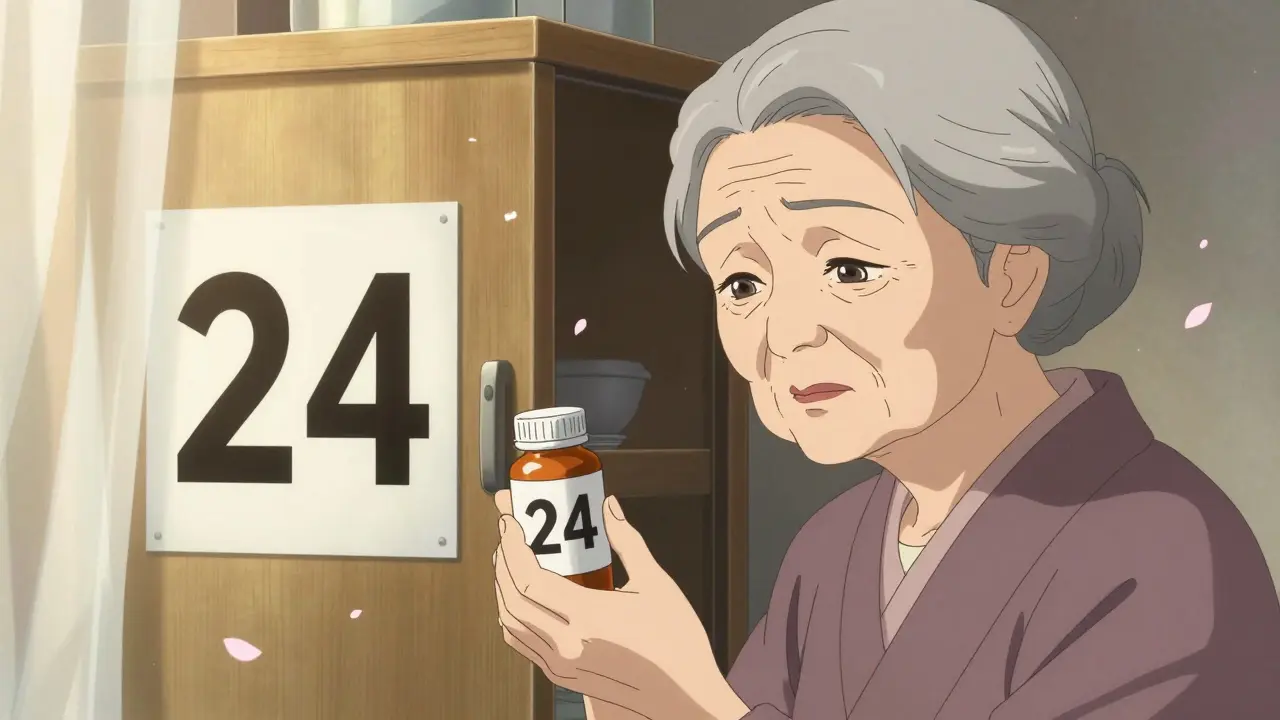
Imagine opening your medicine cabinet and not being able to read what’s inside. Not just a little blurry - but completely unreadable. For over 8 million Americans over 65 with low vision, this isn’t rare. It’s daily. And it’s dangerous. Taking the wrong pill, at the wrong time, in the wrong dose - it happens more often than you think. The good news? There’s a simple, proven fix: large print and accessible prescription labels.
Why Standard Prescription Labels Fail People with Low Vision
Most pharmacy labels are printed in 8- to 10-point font. That’s tiny. Even for someone with perfect vision, it’s hard to read under poor lighting. For someone with macular degeneration, glaucoma, or diabetic retinopathy, it’s impossible. A 2021 CDC survey found that 20% of adults aged 45 and older struggle to read their medication labels. That’s 1 in 5 people. And many of them are taking multiple prescriptions - sometimes 5, 7, or more pills a day. The problem isn’t just about reading. It’s about confusion. Labels often mix uppercase and lowercase letters, use dense formatting, and cram in too much information. Instructions like “Take 1 tab PO qid” mean nothing to most people, even those with normal vision. But for someone with low vision? It’s a puzzle with missing pieces. The result? Medication errors. A study from the National Center for Biotechnology Information found that people with low vision were 3 times more likely to make a dosing mistake than those with full vision. Some took double doses. Others skipped doses. A few even took someone else’s pills by accident. These aren’t hypothetical risks. They lead to hospital visits, falls, organ damage - and sometimes death.What Makes a Prescription Label Actually Accessible?
It’s not just about making the text bigger. Accessibility means clarity, consistency, and ease of use. The American Foundation for the Blind (AFB) and the Access Board have set clear standards - and pharmacies that follow them save lives.- Font size: Minimum 18-point. Some users need 20- or 24-point. Standard pharmacy labels can’t fit all the info at this size - so pharmacies use duplicate labels. One goes on the bottle. The other is a larger version stuck to the side or given separately.
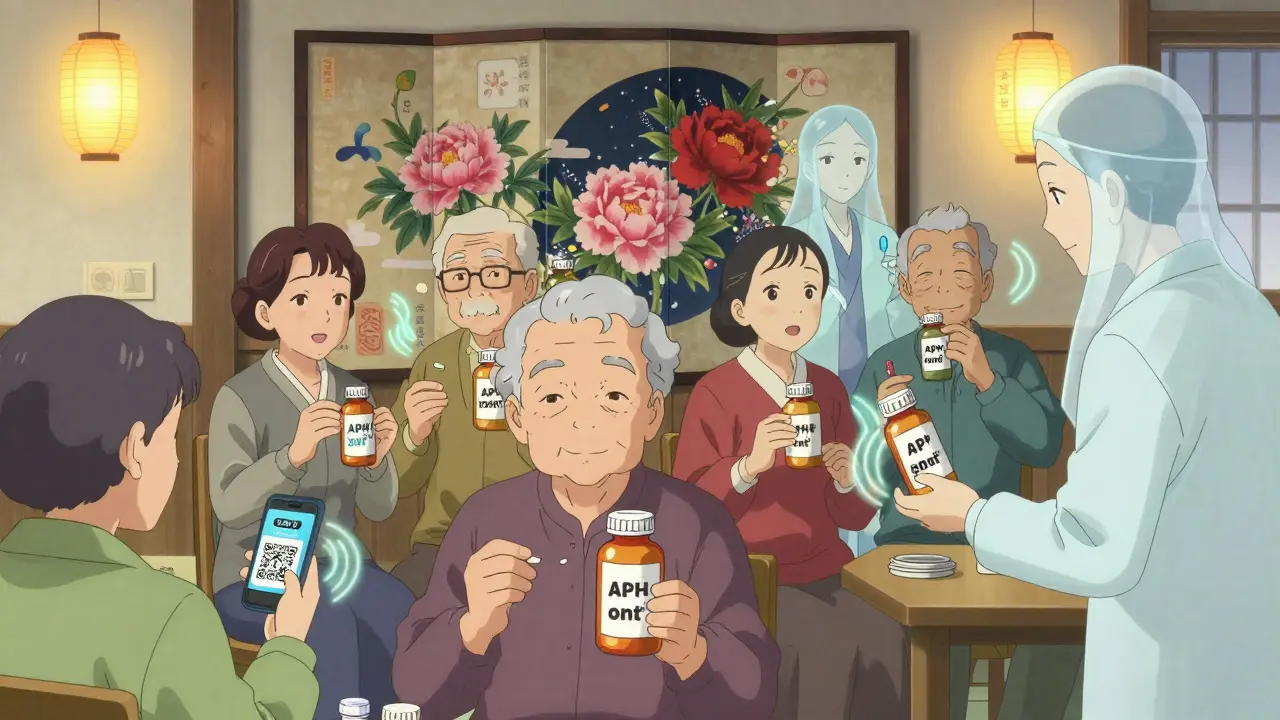
- Font type: Sans-serif fonts like Arial, Verdana, or APHont™ (a free font designed by the American Printing House for the Blind). These are easier to read because they have clean lines and no decorative strokes.
- Contrast: Black text on a white background. No gray, no beige, no pastels. High contrast is non-negotiable.
- Layout: Left-aligned text. No justified edges. Use all lowercase letters except for numbers in instructions (like “Take 2 tablets”). Highlight critical info in yellow - like “Take with food” or “May cause drowsiness.”
- Information: Must include drug name, strength, dosage instructions, prescriber, pharmacy, and expiration date. No jargon. No abbreviations like “qid” or “BID.” Write it out: “Take four times a day.”
Large Print vs. Audible Labels vs. QR Codes: Which One Works Best?
There’s no single solution that fits everyone. Different people need different tools.Large Print Labels
These are the most common and easiest to use. No tech required. Just bigger text. They’re perfect for people who can still see, but need more contrast and size. They’re also the cheapest for pharmacies to implement. Most major chains - CVS, Walgreens, Walmart - offer them for free. You just ask. But they have limits. A standard pill bottle is small. Even with a duplicate label, there’s only so much space. If you take 10 medications, you’ll need 10 large labels. It gets cluttered.Audio Labels (ScripTalk)
ScripTalk is a radio-frequency system. The label has a tiny chip inside. You scan it with a handheld reader (or a smartphone app) and hear the full prescription info spoken aloud. It tells you the drug name, dose, frequency, warnings, refill status - everything. It’s powerful. A user in a 2023 Reddit post said, “Since my pharmacy started offering large print labels (18pt Arial), I’ve stopped taking the wrong pills twice a week like I was doing before - it’s literally life-changing.” But here’s the catch: you need the reader. And you need to know how to use it. For older adults who aren’t tech-savvy, this can be a barrier. That’s why CVS and Walgreens give the readers for free - but many people don’t know they exist.QR Code Labels (ScriptView)
UK HealthCare and others now use QR codes. Scan it with your phone, and it plays an audio recording of your prescription details. Some even link to a webpage with written instructions in large print. This is great because it uses your phone - something most people already have. No extra device needed. But again, you need a smartphone, data, and the ability to use apps. It’s not ideal for everyone.Braille Labels
Only about 10% of people with low vision read Braille. So while it’s essential for that group, it’s not a universal solution. Plus, Braille labels require special printers and take up more space. They’re usually used in combination with large print or audio.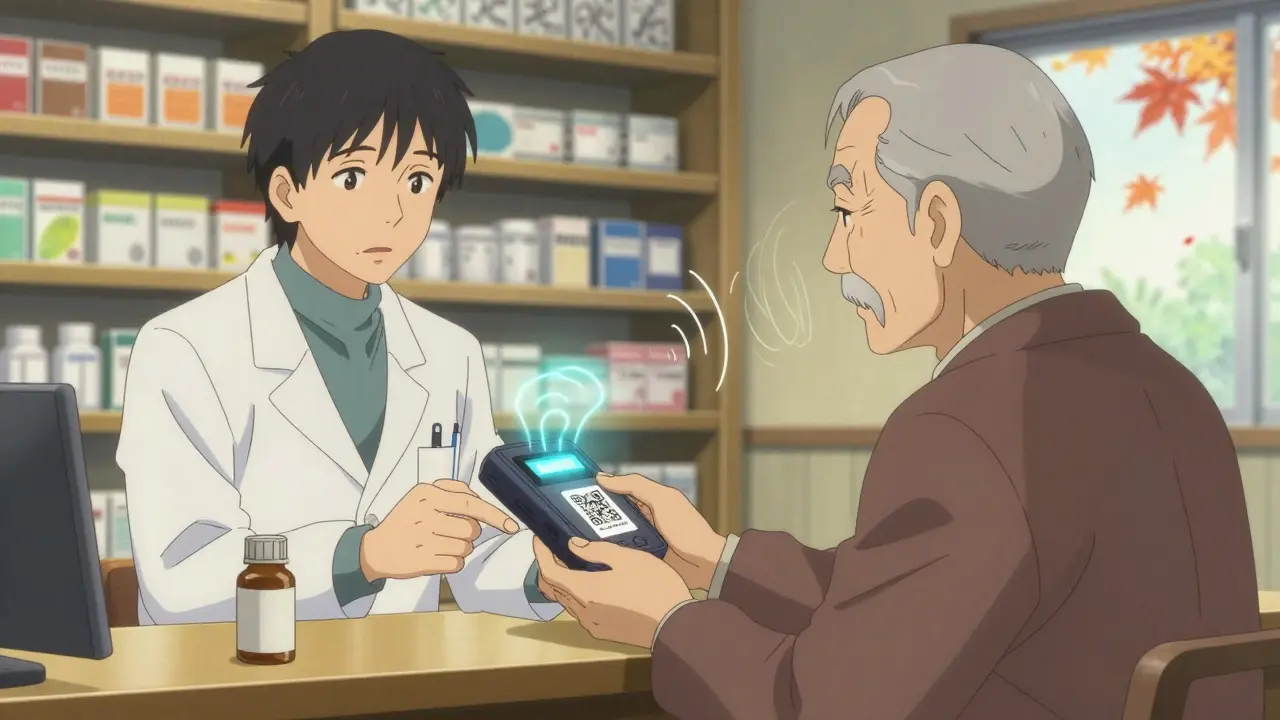
How to Get Accessible Labels - Step by Step
You don’t have to wait for your pharmacy to offer this. You can ask - and you have a legal right to it.- Ask your pharmacist. Say: “I have low vision. Can you print my prescriptions in large print (18-point or larger)?” Don’t say “Do you have this?” Say “Can you do this for me?”
- Ask for ScripTalk or QR code labels. If you have a smartphone, say: “Do you offer audio labels or QR code labels that read out my prescription?”
- Request a duplicate large print label. If the bottle label is too small, ask for a second, larger label to stick on the side or keep in your pill organizer.
- Use free tools. Download APHont™ font from www.aph.org/products/aphont.html. Print your own labels at home if your pharmacy won’t help. Or use the Be My Eyes app - connect live with a volunteer who can read your label over video call.
- Keep a medication list. Write down every pill you take - name, dose, time - in large print. Keep it in your wallet or phone. Use this as backup if a label gets lost.
What Pharmacies Offer - And What They Don’t
The big chains are mostly on board. As of 2023:- CVS: Offers large print, ScripTalk audio labels, and QR code labels. Free. Available in 98% of locations.
- Walgreens: Same options. Free. Available in 95% of stores.
- Walmart: Large print and QR code labels. Free. Available in 92% of locations.
- UK HealthCare: ScriptAbility - free audio, large print, and translated labels.
Real Impact: Stories That Prove It Works
A 78-year-old woman in Kentucky had type 2 diabetes. She was taking insulin, metformin, and a blood pressure pill. She kept mixing up the bottles. She’d take her insulin in the morning instead of at night. She ended up in the ER twice in six months. Her pharmacy switched her to ScriptView - a QR code label that played audio instructions. She scanned it with her phone. She heard: “Insulin: 10 units, before breakfast.” Within three months, her hypoglycemic episodes dropped by 75%. She stopped going to the ER. She started cooking again. She drove to church. That’s not a miracle. That’s accessibility. Another man in Florida, 82, had glaucoma. He couldn’t read his blood thinner label. He was terrified to take it. He stopped. His doctor didn’t know. His INR levels spiked. He almost had a stroke. His pharmacist gave him a large print duplicate label - 24-point Arial, black on white, with yellow highlights for “DO NOT STOP.” He started taking it again. His doctor called him two weeks later: “Your numbers are perfect. What changed?” He said: “I could finally read the label.”What’s Coming Next
The future of prescription labels is digital. CVS is investing $15 million to roll out ScripTalk to all 9,900 of its US pharmacies by late 2024. The FDA is pushing for electronic prescriptions to include accessible formats - meaning your online portal or app must have large print and audio options too. AI tools like Be My Eyes are expanding. The app now connects users with volunteers who can read labels in real time. Over 1.2 million labels have been read this way since June 2023. By 2026, the American Pharmacists Association predicts 100% of US pharmacies will offer large print labels. That’s not a goal. It’s a requirement.Final Thought: This Isn’t a Luxury - It’s a Lifeline
Accessible prescription labels aren’t about convenience. They’re about survival. They’re about dignity. They’re about being able to take care of yourself without relying on someone else to read for you. If you or someone you love has low vision - don’t wait. Don’t assume the pharmacy will offer it. Ask. Demand it. Use the tools. Use the apps. Use the free fonts. Use the QR codes. Use the audio readers. Because no one should have to guess what’s in their pill bottle.Are large print prescription labels free?
Yes. All major pharmacy chains - CVS, Walgreens, Walmart, and others - offer large print, audio, and QR code prescription labels at no extra cost. You don’t need insurance. You don’t need a special form. Just ask your pharmacist.
What font size should a large print prescription label be?
The minimum recommended size is 18-point font. Many users need 20- or 24-point for clear readability. Standard pharmacy labels can’t fit all the info at this size, so pharmacies use duplicate labels - one on the bottle, one larger and separate. Fonts like Arial, Verdana, or APHont™ are preferred for clarity.
Do I need a smartphone to use accessible labels?
No. Large print labels require no technology at all. Audio labels like ScripTalk require a handheld reader, which pharmacies provide for free. QR code labels need a smartphone, but you can also ask your pharmacist to read the label aloud for you if you don’t have one.
Can I get accessible labels if I don’t have Medicare or insurance?
Yes. Accessible prescription labels are a legal right under the Americans with Disabilities Act, not a benefit tied to insurance. You don’t need to be on Medicare, Medicaid, or any plan. All pharmacies must provide them - regardless of how you pay.
What if my pharmacy refuses to give me large print labels?
Ask to speak to the manager. Say: “I’m requesting an accessible label under the Americans with Disabilities Act.” If they still refuse, contact the National Federation of the Blind (NFB) or file a complaint with the Department of Justice. Pharmacies have been fined for not providing these labels - and you have the right to demand them.


Let me just say, the pharmacoeconomic implications of scalable, ADA-compliant labeling infrastructure are non-trivial-especially when you factor in the cost-benefit ratio of reducing medication error-related hospitalizations. The ROI on large-print and audio-label systems is staggering: one study showed a 72% reduction in ER visits among low-vision cohorts. This isn’t charity; it’s fiscal responsibility wrapped in human dignity.
So let me get this straight-you’re telling me pharmacies have been legally required to do this since 2012, and people are still dying because they’re too lazy to print bigger text? Wow. Just wow. No wonder healthcare costs are through the roof.
It is imperative to underscore the statutory obligations delineated under Title III of the Americans with Disabilities Act, wherein pharmacies, as places of public accommodation, are mandated to provide auxiliary aids and services to ensure effective communication. The provision of large-print and audio-based prescription labeling constitutes a reasonable modification under 28 CFR §36.303.
OMG I JUST REALIZED I’VE BEEN TAKING MY BLOOD PRESSURE MEDS AT NIGHT INSTEAD OF MORNING FOR 3 YEARS BECAUSE I COULDN’T READ THE LABEL 😭 I’M GOING TO CVS TOMORROW AND ASKING FOR THE BIG LETTERS NOW
This is one of those things that sounds so obvious you wonder why it wasn’t done years ago. Bigger text. Clear instructions. No jargon. Simple. And yet so many people still suffer because nobody thought to make it easy. It’s not magic-it’s just basic human care.
My grandma started using ScripTalk last year. She hasn’t missed a dose since. She says it’s like having a quiet voice in her pocket telling her what to do. No more guessing. No more panic. Just peace.
There is a critical error in your article: you refer to 'qid' as jargon, yet you fail to clarify that 'qid' is an abbreviation for 'quater in die,' Latin for 'four times a day.' While I agree it should be avoided for accessibility, mischaracterizing it as mere 'jargon' demonstrates a lack of linguistic precision. Furthermore, you cite a 2021 CDC survey without providing a direct link or DOI. This undermines credibility.
If you’re reading this and you’re worried your pharmacy won’t help-just ask. Say it like you mean it. ‘I need this to stay safe.’ Most pharmacists want to help. They just don’t always know you’re asking. Don’t be shy. You’re not asking for a favor-you’re claiming your right.
Wait… so you’re telling me the government is forcing pharmacies to give out free labels… but they’re NOT telling you about the QR code tracking? Who’s really behind this? Is Big Pharma secretly harvesting data from every scan? And why is APHont™ free? What’s the catch? Someone’s monetizing our blindness.
I used to work at a small pharmacy. We didn’t have the budget for ScripTalk readers. We’d print extra labels by hand on cardstock. We’d call patients if they hadn’t picked up. We did what we could. Don’t act like every mom-and-pop shop is just ignoring the law. They’re just drowning.
Key point: 18pt is the baseline. But for macular degeneration, 24pt is the sweet spot. And don’t forget font weight-bold helps. Also, line spacing: 1.5x minimum. And never, ever use justified alignment. It creates rivers of white space that break reading flow. These aren’t opinions-they’re WCAG 2.1 guidelines.
In India, we don’t have this yet. But I’m starting a campaign in my city. I printed 50 sample labels with 24pt Arial and handed them to local pharmacists. One said, ‘We never thought of this.’ Now three are trying it. Change starts with one person asking.
As a speech-language pathologist who works with elderly patients, I can attest: clarity in medication instructions reduces cognitive load significantly. When patients aren’t decoding cryptic abbreviations, they retain more information. This isn’t just about vision-it’s about cognitive accessibility.
QR codes? Audio labels? 😎 You think they’re helping? Nah. This is all part of the surveillance rollout. Every scan = data point. Every voice recording = voiceprint. They’re building a biometric profile of every senior who takes meds. And don’t even get me started on the 5G chip in the ScripTalk reader… 🤫👁️