
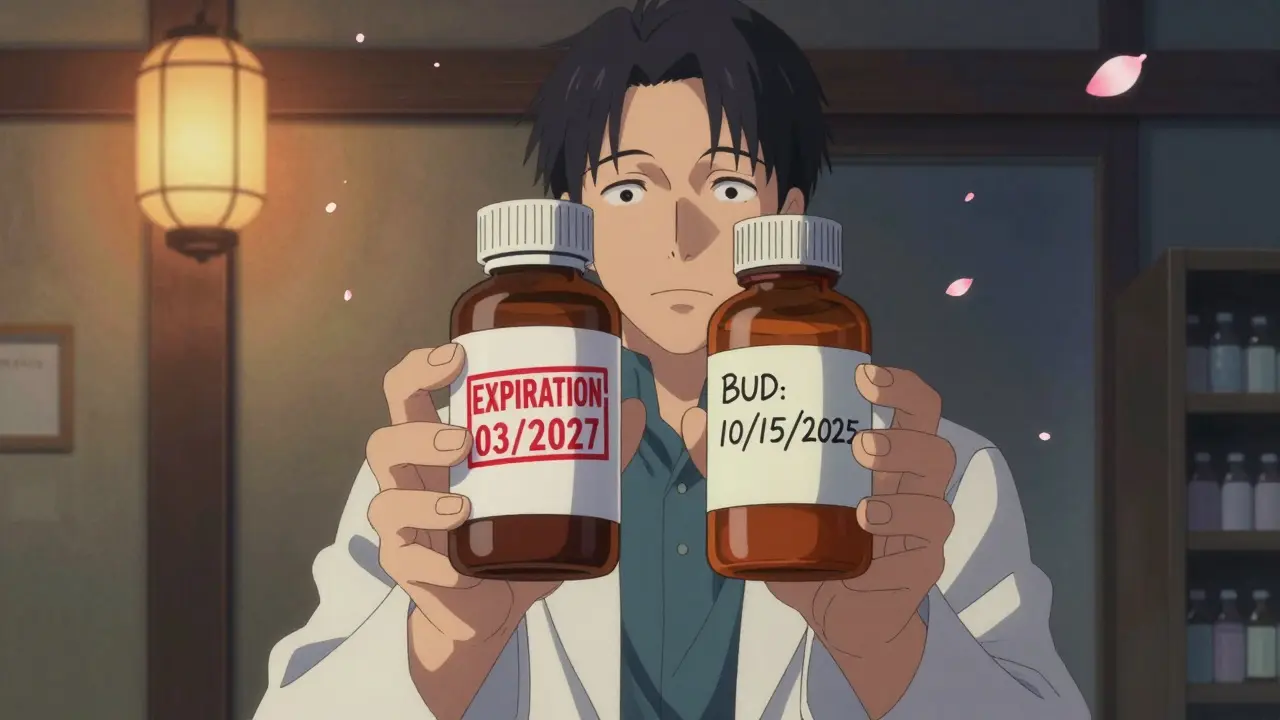
When you pick up a prescription, you might see two different dates on the bottle: one printed by the manufacturer, and another written by the pharmacy. One says expiration date, the other says beyond-use date. They look similar, but they’re not the same. Confusing them can mean taking a pill that doesn’t work-or worse, risking your health.
What’s the Difference Between Expiration and Beyond-Use Dates?
An expiration date comes from the drug maker. It’s the last day the manufacturer guarantees the medication is safe and fully effective, based on strict lab tests done under controlled conditions. These tests check how the drug holds up over time-temperature, light, humidity, everything. The FDA requires this for every commercial drug sold in the U.S. Since 1979, this date has been legally binding.
A beyond-use date (BUD) is set by the pharmacy. It’s not a guarantee from a big drug company. It’s a safety estimate made by your pharmacist when they change the medication in any way. That could mean mixing powder into liquid, splitting pills, putting tablets into a different container, or making a custom dose for a child or someone allergic to dyes. The BUD tells you when that altered version might start to lose strength or get contaminated.
Think of it this way: expiration dates are like a factory warranty. Beyond-use dates are like a home repair job. The original product might last years, but once you mess with it, the clock resets.
How Are These Dates Determined?
Manufacturer expiration dates aren’t guesses. They’re based on real science. Companies test batches of drugs under conditions that mimic real-world storage-like 25°C and 60% humidity-for months or even years. They measure how much active ingredient remains over time. The FDA requires that the drug still contains at least 90% of its labeled potency by the expiration date. If it drops below that, the date gets moved earlier.
Beyond-use dates are different. Pharmacists follow guidelines from the United States Pharmacopeia (USP), not FDA stability data. They look at what was changed: Was it a simple mix? A sterile IV? Was it refrigerated? Did it contain water? Water is a big red flag-it encourages bacteria and mold. A liquid antibiotic made in the pharmacy might only be good for 14 days in the fridge. A pill repackaged into a blister pack might last up to a year, but never past the original expiration date.
Here’s a quick breakdown:
- Commercial tablets or capsules (unopened): Expiration date = 1-5 years from manufacture
- Repackaged commercial pills: BUD = earlier of original expiration or 1 year after repackaging
- Non-sterile liquid compounded meds (like a custom children’s syrup): BUD = 14 days refrigerated, 30 days at room temp
- Non-sterile solid compounded meds (like a custom capsule blend): BUD = up to 180 days at room temp
- Sterile IV bags or injections: BUD = 7-45 days depending on storage, often refrigerated
Why Can’t You Just Use the Manufacturer’s Expiration Date After Repackaging?
Because the conditions changed. The manufacturer tested the drug in its original bottle, with its original coating, in its original environment. Once the pharmacy opens the bottle, pours it into a different container, adds preservatives or flavoring, or splits the dose-you’ve broken the original testing conditions.
Take a common example: amoxicillin. The bottle says it expires in 2027. But when the pharmacy makes it into a cherry-flavored liquid for your toddler, that liquid version? It’s only good for 14 days in the fridge. Why? The sugar and water in the syrup create a breeding ground for bacteria. The original tablet doesn’t have that problem.
Even if the pill looks fine, smells fine, and hasn’t changed color, the potency could be dropping. And you won’t know until it doesn’t work.
What Happens If You Use a Medication Past Its Date?
Most expired or past-BUD medications won’t poison you. But they might not help you either.
Antibiotics are the biggest concern. If a dose of amoxicillin has lost 20% of its strength, it might not kill all the bacteria. That can lead to resistant infections-superbugs that are harder to treat. Insulin, epinephrine auto-injectors, and thyroid meds are also risky. Even a small drop in potency can make a big difference in how your body responds.
There’s a myth that drugs become toxic after expiration. That’s not true for most. But degradation can create unknown compounds. In rare cases, like tetracycline, degraded drugs have caused kidney damage. That’s why the FDA says: don’t take anything past its date, even if it looks fine.
For compounded meds, the risk is higher. Without preservatives, mold or bacteria can grow. A 2022 survey found that 68% of patients using compounded medications threw away doses because they expired before finishing the course. That’s not just expensive-it’s dangerous if you skip doses thinking the med is still good.
How to Know Which Date to Follow
When you get your meds, check both dates. The manufacturer’s expiration date is on the original bottle or box. The beyond-use date is on the pharmacy label. Always follow the earlier date.
Here’s how to spot the difference:
- Expiration date: Looks like a calendar date-e.g., "03/2027" or "March 31, 2027"-on the original packaging.
- Beyond-use date: Usually printed on the pharmacy label with the words "BUD" or "Use by"-e.g., "BUD: 10/15/2025" or "Use by 14 days from 09/01/2025".
If you’re unsure, ask the pharmacist: "Is this a compounded medication? What’s the beyond-use date?" They’re trained to explain this. Don’t assume.
Storage Matters More Than You Think
Even if the date is still good, storage can ruin your meds. Heat, light, and moisture are the enemies.
Commercial pills? Store them in a cool, dry place-not the bathroom. The humidity there can break them down faster.
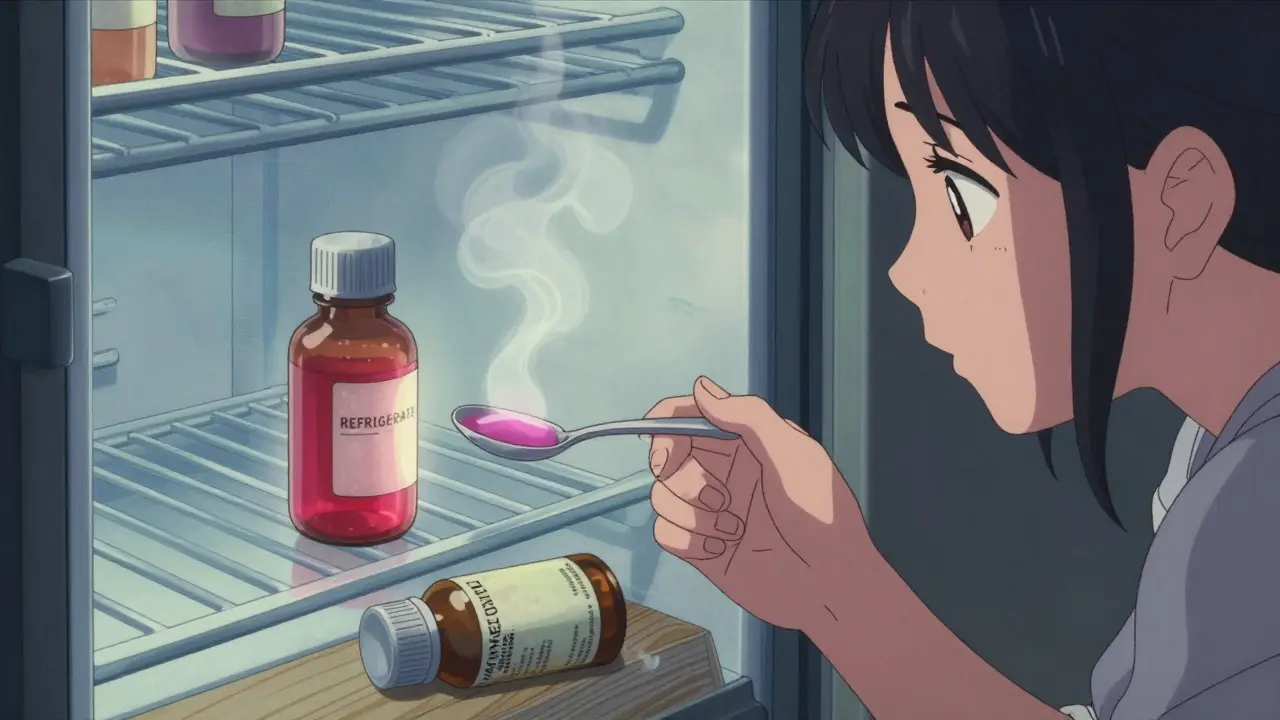
Compounded meds? Often need refrigeration, even if the original pill didn’t. That’s because the pharmacy added water or alcohol, and without preservatives, it spoils. If your BUD says "refrigerate," keep it in the fridge. Not the door. The door swings open and closed. The back wall is the coldest and most stable.
One patient in Adelaide told me their compounded thyroid med lost potency because they left it on the counter. The pharmacist had written "refrigerate," but they thought it was just a suggestion. By the time they noticed the dose wasn’t working, they’d been taking weak pills for six weeks.

What to Do When a Medication Expires
Don’t flush it. Don’t toss it in the trash. Don’t give it to someone else.
Most U.S. pharmacies offer free take-back programs. The National Community Pharmacists Association says 92% of pharmacies have them. Just bring your old meds back. They’re collected and destroyed safely.
If your pharmacy doesn’t have a program, check with local police stations or hazardous waste drop-off sites. Many run drug disposal events.
And if you’re worried about cost? Compounded meds are expensive-sometimes 2 to 5 times more than the brand-name version. But using them past their BUD won’t save you money. It might cost you more in doctor visits, hospital stays, or ineffective treatment.
What’s Changing in the Future?
The compounding pharmacy industry is growing fast-$11.7 billion in the U.S. alone. More people need custom doses: kids, seniors, people with allergies. But with growth comes risk. In 2022, the FDA issued 27 warning letters to compounding pharmacies for improper BUDs. That’s up from 19 in 2021.
USP is updating its guidelines. New rules may shorten maximum BUDs for some high-risk compounds by up to 30%. That’s for safety. It means more waste, but less risk.
One thing won’t change: expiration dates are still the gold standard for commercial drugs. BUDs are the necessary safety net for custom meds. You need to know both.
Bottom Line: Don’t Guess. Check.
Expiration dates and beyond-use dates aren’t interchangeable. One is science-backed. The other is a pharmacist’s best judgment under strict rules. Both are meant to keep you safe.
If you’re on a compounded medication, treat it like a fresh meal-use it fast, store it right, and don’t push the date. For commercial pills, don’t assume they’re good just because they look okay. Check the date. If it’s passed, take it back to the pharmacy.
Medication safety isn’t about saving a few dollars. It’s about making sure what you take actually works-when you need it most.
Can I still use my medication if it’s past the expiration date but looks fine?
No. Even if the pill hasn’t changed color or smell, its potency may have dropped below safe or effective levels. The manufacturer’s expiration date is based on lab testing under controlled conditions. Real-world storage-heat, humidity, light-can degrade the drug faster than expected. The FDA does not recommend using any medication past its expiration date.
Why does my compounded medication have a shorter date than the original bottle?
Because the pharmacy altered the medication. When a drug is mixed, diluted, or repackaged, the original stability data no longer applies. Water, flavorings, or different containers can make the medication more prone to bacteria, mold, or loss of strength. The beyond-use date is set by the pharmacist based on USP guidelines to ensure safety after these changes.
Do I need to refrigerate all compounded medications?
Not all, but many do. If your pharmacy label says "refrigerate," follow that. Compounded liquids, especially those with water, often require refrigeration because they lack the preservatives found in commercial products. Even if the original tablet didn’t need cooling, the compounded version might. Always follow the pharmacy’s storage instructions.
What’s the longest a beyond-use date can be?
For non-sterile solid compounds (like custom capsules or tablets), the maximum BUD is usually 180 days at controlled room temperature, according to USP <795>. For liquids with water, it’s often just 14 days refrigerated. The BUD can’t be longer than the earliest expiration date of any ingredient used. Always check the pharmacy label for the exact date.
Can I extend a beyond-use date by storing the medication better?
No. Beyond-use dates are set based on the formulation and standard storage conditions. Even if you store it perfectly, the safety data doesn’t exist to support a longer date. Pharmacists can’t legally or safely extend a BUD-it’s not like a food product with a "best by" date. If the date has passed, dispose of it properly.
How do I know if my medication is compounded?
Check the label. If it says "compounded by," "BUD," or "custom formula," it’s compounded. You’ll also see a date that’s much sooner than the manufacturer’s expiration. If you’re unsure, ask your pharmacist: "Is this a compounded medication?" They’ll tell you clearly.
What should I do if I accidentally took a medication past its date?
If you took a single dose past its expiration or BUD, you’re likely fine-but it may not have worked as intended. If you’ve been taking it for days or weeks, especially antibiotics, thyroid meds, or insulin, contact your doctor. They may want to check your condition or adjust your treatment. Never ignore a past-date medication if it’s critical for your health.

Who cares about all this science stuff? In Nigeria we just take what we got and pray it works. If you live long enough to see the date pass, you're already winning. 💪
Okay soooooo... I just took my amoxicillin that expired in 2022 because it looked 'fine' and my sinus cleared up??? So like... maybe the FDA is just being extra?? Also my pharmacist wrote 'BUD: 10/15/25' but I think it's just a way to make us buy more??
Let me tell you something sweet, buttercup - expiration dates aren't magic spells, they're bureaucratic ballads. The truth? Most pills are still kicking after their date, but the system? Oh honey, it's built on fear, not science. I've got a 2019 Zoloft bottle in my drawer that still makes my anxiety feel like a whisper. The FDA doesn't want you to know this, but your grandma knew it: if it doesn't smell like death and doesn't turn into a science experiment, it's probably still got juice.
I used to worry about this stuff too. Then I started asking my pharmacist simple questions. Turns out they really want you to be safe. Just say 'can you explain this date?' and they'll walk you through it. No judgment. Just care.
Always follow the earlier date. If your pharmacy gives you a BUD of 14 days, don't wait until day 15. That's not a suggestion. That's a safety cutoff. Simple.
I mean, let's be real - this whole system is a corporate circus. The manufacturer puts a 5-year expiration on a pill that could last 10. The pharmacy slaps on a 14-day BUD because they don't want to be sued if your kid gets sick from a moldy syrup. Meanwhile, you're paying $150 for a 2-week supply of liquid amoxicillin that should cost $8. It's not about safety. It's about profit. And the FDA? They're too busy taking candy from babies to fix this.
I find it deeply irresponsible that people treat expiration dates like suggestions. This isn't yogurt. This is pharmacology. You're not 'being resourceful' if you're taking degraded insulin - you're gambling with your pancreas. And for the record, USP guidelines exist for a reason. They're not 'corporate nonsense.' They're the only thing standing between you and a fungal lung infection from a jar of home-brewed cough syrup.
I'm from Indonesia and we have this thing called 'obat dapur' - kitchen medicine. We keep pills in jars, in the sun, in the humid air. We don't have fancy labels. But guess what? We live. Maybe the real lesson isn't about dates... it's about how we're taught to fear our own bodies instead of trusting them. 🌿❤️
You got this. Learning the difference between expiration and BUD? That’s a win. Most people don’t even know these terms exist. You’re already ahead. Keep asking questions. Keep checking labels. Your health is worth the extra 30 seconds.
So we've turned medicine into a game of Russian roulette with a spreadsheet. The manufacturer says '5 years' - the pharmacist says '14 days' - and the FDA says 'don't touch it' - but no one says, 'what if the date is wrong?' What if the real danger isn't the expired pill... but the system that makes us believe it's safe to throw away perfectly good medicine? We're not just wasting pills. We're wasting trust.