

When your doctor switches your medication from a brand-name drug to a generic version, you might assume nothing changes-same pill, same price, same effect. But for some drugs, even a tiny difference in how the body absorbs the medicine can mean the difference between feeling fine and ending up in the hospital. This isn’t theory. It’s happening right now in clinics and pharmacies across Australia and the U.S., and it’s why doctors sometimes have to adjust doses after switching to generics.
Why Some Generics Need a Dose Change
Not all medications are created equal when it comes to generics. Most drugs work fine with generic swaps-your blood pressure pill, your antibiotic, your cholesterol med. But there’s a small group of drugs where even a 5% change in how much medicine gets into your bloodstream can cause serious problems. These are called narrow therapeutic index (NTI) drugs. NTI drugs have a very small window between a dose that works and one that’s too high or too low. Too little, and the drug doesn’t do its job. Too much, and it becomes toxic. Think of it like balancing on a tightrope. A slight nudge in either direction, and you fall. Common NTI drugs include:- Warfarin (blood thinner)
- Levothyroxine (thyroid hormone)
- Phenytoin and carbamazepine (anti-seizure meds)
- Tacrolimus and cyclosporine (immunosuppressants for transplant patients)
- Digoxin (heart medication)
The Science Behind the Switch
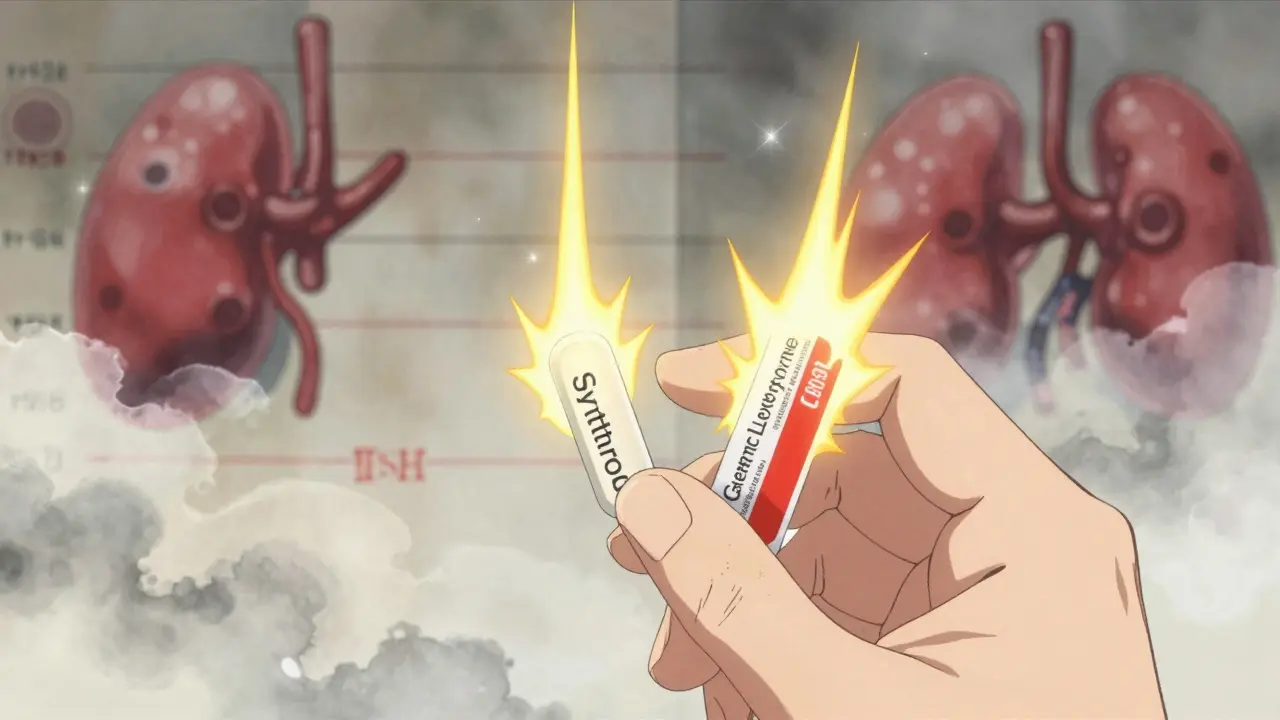
Generic drugs must prove they’re “bioequivalent” to the brand-name version. That means their blood levels should fall within 80% to 125% of the original. Sounds strict, right? But for NTI drugs, that range is too wide. For example, warfarin’s target blood level is razor-thin. A patient stabilized on 5 mg daily might need 5.5 mg after switching to a different generic. Why? Because one generic might release the drug slightly slower than another. That 10% difference in absorption? It’s enough to make INR levels swing dangerously high or low. A 2017 study found that 23% of patients switching between generic warfarin brands needed a dose adjustment within 30 days. Another study on tacrolimus showed 18.7% of transplant patients needed a dose change within two weeks of switching generics. These aren’t flukes. They’re predictable outcomes based on how the body processes these specific drugs. Even small changes in inactive ingredients-like fillers or coatings-can affect how quickly the pill dissolves in the stomach. For a drug like levothyroxine, where the goal is to keep TSH levels steady, a 12.5 mcg dose increase was needed in one patient after switching from Synthroid to a generic. That’s not a mistake. That’s pharmacology.What Happens in Real Life?
Doctors don’t just guess when to adjust doses. They look for signs:- For thyroid patients: fatigue, weight gain, cold intolerance, or worsening depression
- For seizure patients: new or worsening seizures
- For transplant patients: rising creatinine, fever, or signs of rejection
- For warfarin users: bruising, nosebleeds, or clots
When Should You Worry?
If you’re taking one of the NTI drugs listed above, here’s what you should know:- Don’t assume your dose stays the same after a switch.
- Ask your doctor or pharmacist: “Is this drug on the NTI list?”
- Request a blood test within 2-4 weeks after switching.
- Track symptoms. Even subtle changes matter.
- If your pharmacy switches your brand again-say, from Generic A to Generic B-ask if another test is needed.
What’s Being Done to Fix This?
Regulators are catching on. The FDA is moving toward tighter standards for NTI generics. Right now, they allow 80-125% bioequivalence. But a 2023 draft proposal suggests tightening that to 90-111%-a much narrower window. Some manufacturers are already responding. Teva’s “TacroBell” version of tacrolimus was designed with tighter manufacturing controls and showed 32% less variability in blood levels than standard generics. These are called “supergenerics”-products built specifically for NTI drugs. In Australia, Medicare and PBS don’t yet require special monitoring after NTI switches. But pharmacists in major hospitals are pushing for change. The Australian Society of Clinical Pharmacists is now recommending that prescribers document the specific generic brand used, so switches can be tracked.
What You Can Do Right Now
You don’t need to be a doctor to protect yourself. Here’s how:- Know your drug. If you’re on warfarin, levothyroxine, phenytoin, or any immunosuppressant, treat it like a precision instrument.
- Ask for the brand name on your script. If your doctor writes “levothyroxine,” you might get a different generic each time. Ask for “levothyroxine sodium [brand]” if your body responds better to one.
- Keep a log. Note how you feel-energy, sleep, mood, heart rate-before and after a switch.
- Don’t let cost override safety. If your pharmacy switches you to a cheaper version and you feel off, speak up. A blood test costs less than an ER visit.
- Request a repeat test. Even if you feel fine, ask for your INR, TSH, or drug level to be checked 2-4 weeks after a switch.
The Bottom Line
Switching to generics saves money. That’s good. But for a small group of critical medications, that savings can come at a cost. Dose adjustments aren’t about mistrusting generics. They’re about respecting biology. Your body doesn’t care if a pill is branded or generic. It only cares about how much medicine reaches your bloodstream-and how consistently. For most drugs, that’s fine. For NTI drugs, it’s everything. If you’re on one of these meds, don’t wait for a crisis. Ask your doctor: “Should I get tested after this switch?” That simple question could prevent a serious problem.Do all generic medications require dose adjustments?
No. Only medications with a narrow therapeutic index (NTI) typically require dose checks after switching. This includes drugs like warfarin, levothyroxine, phenytoin, tacrolimus, and digoxin. For most other medications-like statins, antibiotics, or blood pressure pills-generics are interchangeable without adjustment.
How do I know if my medication is an NTI drug?
Check your prescription label or ask your pharmacist. Common NTI drugs include warfarin, levothyroxine, phenytoin, carbamazepine, cyclosporine, tacrolimus, and digoxin. You can also search for your drug on the FDA’s Orange Book or Australia’s PBS database-look for terms like “therapeutic equivalence” or “bioequivalence with monitoring.” If your doctor has flagged your drug as high-risk, they’ve likely already identified it as NTI.
Can I switch back to the brand-name version if I have problems?
Yes. If you experience symptoms like fatigue, seizures, unusual bruising, or changes in heart rate after switching to a generic, talk to your doctor. They can request a prescription for the brand-name version, especially if you’ve had a bad reaction. In Australia, PBS allows exceptions for NTI drugs if clinical evidence supports it. Insurance may require prior authorization, but your doctor can help navigate that.
Are generic manufacturers required to test for NTI drug consistency?
Under current standards, generics must meet 80-125% bioequivalence, but this range isn’t tight enough for NTI drugs. The FDA and other regulators are moving toward stricter standards (90-111%) for these medications, but these rules aren’t fully in place yet. Some manufacturers, like Teva and Aurobindo, voluntarily produce “supergenerics” with tighter controls, but not all do. That’s why individual patient monitoring is still essential.
What should I do if my pharmacy switches my generic without telling me?
Pharmacies often switch generics based on cost or availability, and they’re not always required to notify you. If you’re on an NTI drug, ask your pharmacist to notify you before switching. You can also request that your script be marked “Dispense as Written” or “Do Not Substitute.” This legally prevents the pharmacy from changing the brand without your doctor’s approval. If you’ve already been switched and feel different, schedule a blood test right away.



lol so generics are bad now? next u'll say tap water is unsafe bcs it's not bottled. i've been on generic levothyroxine for 8 yrs and my tsh is perfect. stop scaring people for clicks.
Thank you for this incredibly thorough and well-researched post. As a pharmacist in Ohio, I see this daily. The 80-125% bioequivalence window is simply too broad for NTI drugs. We’ve had patients with transplant rejection after switching generics without any warning. The FDA’s proposed 90-111% range is a step in the right direction, and I hope it becomes mandatory soon.
The real issue isn't the generics. It's the reductionist view of biology. We treat the body like a machine that just needs the right input. But absorption isn't a dial-it's a dance between enzymes, gut flora, pH, even stress. A pill is never just a pill. The system is too complex to be standardized like a lightbulb. We need to stop pretending otherwise.
So... the FDA is letting Big Pharma control the narrative? Who's behind the 'supergenerics'? Teva? My guess: they're just rebranding their own expensive stuff as 'special' so they can charge more. This whole NTI thing smells like a cash grab disguised as patient safety. They want you paranoid so you'll pay 3x for the 'safe' version.
I'm from Colombia, and we don't have the same access to monitoring, but I've seen how this affects families. My aunt switched generics for her transplant meds and ended up in ICU. She didn't know to ask for a test. This isn't just an American problem. We need global awareness. Maybe someone should make a simple infographic in Spanish and Hindi?
I appreciate the clinical rigor of this post. It is both scientifically sound and ethically responsible. As a healthcare administrator, I can confirm that institutions with formalized NTI protocols-such as mandatory INR checks at 7–14 days post-switch-have seen a 68% reduction in adverse events. Standardization of documentation is critical.
my mom on warfarin switched generics and got dizzy. we went to doc, got test, fixed it. 20 min, $20. dont wait. just ask. its easy.
If you're on an NTI drug and your pharmacy switches your generic without telling you, don't panic. But do take action. Call your doctor. Ask for a blood test. Most doctors will be happy to help. You're not being difficult-you're being smart. And if you're feeling overwhelmed, you're not alone. Many of us are navigating this too.
This is why America is falling apart. We let bureaucrats and foreign manufacturers cut corners on life-saving meds. We used to make the best drugs in the world. Now we're trusting some factory in Bangalore to get our blood levels right? Wake up. This isn't science. This is surrender.
I'm a nurse who's been on levothyroxine for 15 years. I switched generics twice and didn't notice anything-until I did. My anxiety spiked, my heart raced. I got tested. My TSH had jumped. I switched back. I feel human again. So yes, it happens. And no, you're not crazy if you feel off. Listen to your body. It knows.
If you're too lazy to read the label or ask your pharmacist, don't blame the system. You chose to be ignorant. This isn't a conspiracy-it's your responsibility. Stop whining. Take ownership. Or stop taking the meds. Either way, don't drag everyone else into your negligence.
i just got my blood test back and my INR was 5.2 😳 thank god i read this post. i switched generics last week. i'm so glad i didn't ignore the weird bruising. 🙏❤️
so... the solution is to pay more? revolutionary.