

If you're taking warfarin, a blood thinner used to prevent clots, you’ve probably been told to watch your diet. But one of the most dangerous and often overlooked food interactions isn’t with cheese or leafy greens-it’s with cranberry products. Even if you’ve been drinking cranberry juice for years to prevent urinary infections, that habit could be putting you at serious risk of internal bleeding. This isn’t theoretical. Real people, real hospitals, and real emergencies have happened because of it.
What Happens When Cranberry Meets Warfarin
Warfarin works by slowing down your blood’s ability to clot. It’s precise. Too little, and you risk a stroke or pulmonary embolism. Too much, and you can bleed internally-sometimes without even knowing it. Doctors monitor this with a blood test called INR. A normal range is 2.0 to 3.0. Anything above 4.5 is dangerous. Above 6.0? That’s an emergency. Cranberry products-juice, capsules, extracts, even flavored sodas-can push that INR sky-high. In documented cases, people on stable warfarin doses saw their INR jump from 2.5 to over 8.0 within days of starting cranberry juice. One 78-year-old man in Los Angeles was drinking half a gallon of cranberry-apple juice every week. His INR hit 6.45. He nearly bled out. Another woman, taking cranberry cocktail daily, developed stomach bleeding after her INR soared to 8.3. The reason? Cranberries contain compounds called flavonoids, especially quercetin. These interfere with an enzyme in your liver called CYP2C9. That enzyme is responsible for breaking down the active part of warfarin. When it’s blocked, warfarin builds up in your bloodstream. It’s like turning up the volume on your blood thinner without changing the dose.The Evidence Isn’t Perfect-But the Risk Is Real
Some studies say cranberry doesn’t affect warfarin. That’s true. But those studies often used small amounts, short durations, or inconsistent products. Real-world cases tell a different story. The FDA added a warning to warfarin labels in 2005 after dozens of bleeding incidents. Health Canada, the European Medicines Agency, and New Zealand’s Medsafe all followed suit. New Zealand’s drug safety agency received 33 reports of warfarin interacting with food or supplements between January and September 2022. Cranberry was a major contributor. One Reddit thread from the r/anticoagulants community had over 140 upvotes on posts from people whose INR spiked after cranberry juice. One user wrote: “My INR went from 2.4 to 4.1 in one week. My hematologist said stop everything cranberry-no exceptions.” Yet another user in the same thread said they’d taken cranberry pills for five years with no issues. That’s the problem. Some people are more sensitive than others. Genetics play a role. If you have a variant of the CYP2C9 gene (like *CYP2C9*2 or *CYP2C9*3), your body processes warfarin slower to begin with. Add cranberry, and your INR can spike two to three times more than someone without that gene. You might not know you have it-until it’s too late.All Forms of Cranberry Carry Risk
It’s not just juice. Capsules, tablets, powders, and even cranberry-flavored yogurt or soda can contain enough active compounds to matter. Sweetened cranberry juice cocktails? They’re worse. Manufacturers often concentrate the juice to make it taste better, which means higher levels of the compounds that interfere with warfarin. The Merck Manual, a trusted medical reference updated in 2023, says plainly: “People taking warfarin should avoid cranberry products.” The American College of Chest Physicians agrees. Their 2021 guidelines say: Avoid cranberry unless you’re getting INR checks every 3-5 days after starting it-and even then, it’s not recommended. There’s no safe amount. Not one glass a week. Not one capsule a month. If you’re on warfarin, cranberry is a gamble with your life. And the odds aren’t in your favor.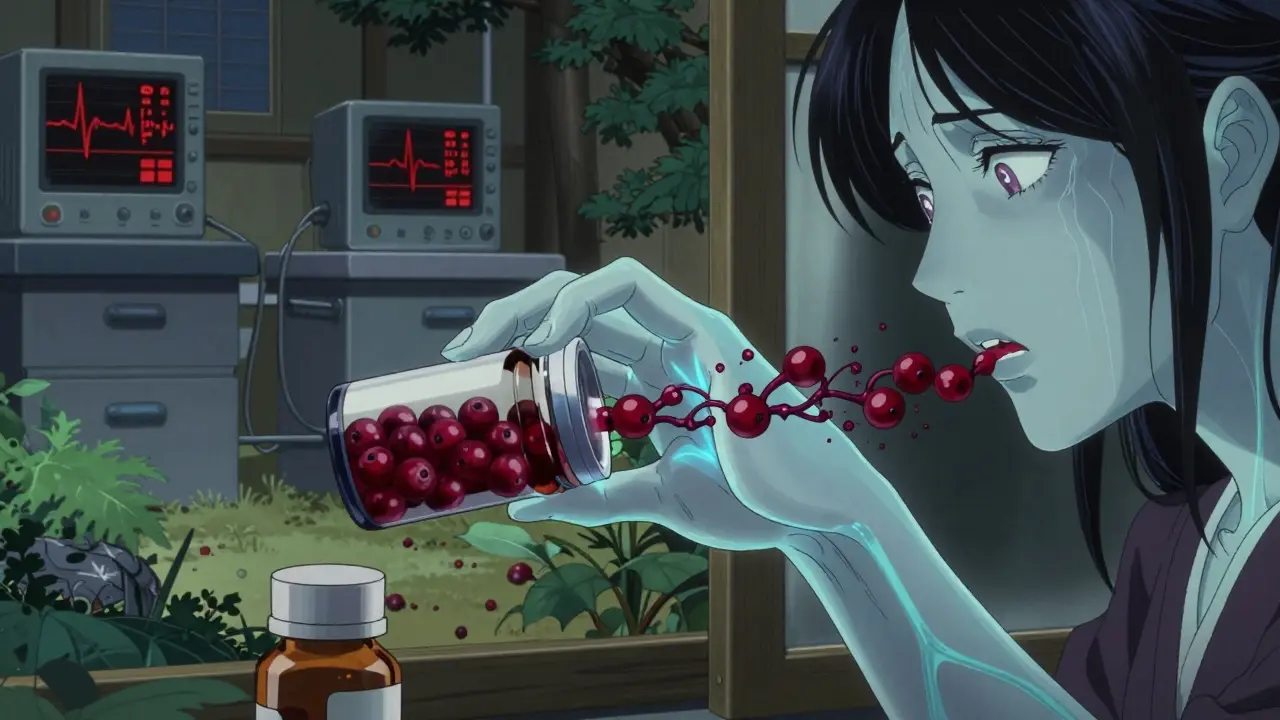
What Should You Do Instead?
If you’re taking cranberry to prevent urinary tract infections (UTIs), you’re not alone. But there are safer alternatives. Methenamine hippurate is a non-antibiotic that works by making your urine acidic, which kills bacteria. Low-dose antibiotics taken daily are another option, especially if you get frequent UTIs. Drinking plenty of water, peeing after sex, and avoiding irritants like caffeine and alcohol are also proven strategies. If you’ve been drinking cranberry juice for years and don’t want to quit cold turkey, talk to your doctor. Don’t just stop. Don’t guess. Get an INR test right away. If your level is normal, you might be one of the rare people who don’t react. But don’t assume that’s you. Keep monitoring. Switch to a different method for UTI prevention. Your life isn’t worth the risk.Monitoring and What to Watch For
If you accidentally consume cranberry and are on warfarin, watch for signs of bleeding:- Bleeding gums when brushing teeth
- Nosebleeds that won’t stop
- Unusual bruising, especially without injury
- Dark, tarry stools or blood in urine
- Severe headaches, dizziness, or weakness-signs of brain bleeding



It’s fascinating-really, profoundly unsettling-how we’ve been conditioned to believe that ‘natural’ equals ‘safe,’ when in reality, nature is a chaotic, unpredictable ecosystem where compounds like quercetin don’t care about your INR, your doctor’s advice, or your belief that ‘it’s just juice’… and yet, we treat cranberry like it’s a harmless herbal tea, not a biochemical saboteur operating in the shadows of your hepatic CYP2C9 pathway… it’s not just ignorance-it’s a cultural delusion wrapped in a cranberry-colored bow.
How tragic, really, that a product marketed as a wellness elixir has become, for so many elderly patients, a silent assassin-especially when pharmacists, who are trained to catch these interactions, are often too overworked to mention it. And yet, we still expect patients to be medical experts. This isn’t a failure of the patient-it’s a failure of the system that allows ‘natural’ to mean ‘no warnings required.’
Look, I’ve been on warfarin for 8 years. I drink cranberry juice every morning. Nothing’s happened. So stop with the fearmongering. If your INR spikes, maybe you’re just bad at following your meds-not because of juice.
While individual tolerance varies, the clinical consensus is clear: cranberry products interfere with warfarin metabolism via CYP2C9 inhibition, and this is not a marginal risk. The FDA, Health Canada, and the European Medicines Agency have all issued warnings based on documented cases of life-threatening INR elevation. To dismiss this as anecdotal is to misunderstand how pharmacovigilance works-individual exceptions don’t invalidate population-level risks. Safety guidelines exist precisely because not everyone reacts the same way, and some reactions are irreversible.
OMG I JUST REALIZED I’VE BEEN DRINKING CRANBERRY SODA FOR 3 YEARS 😱 I THOUGHT IT WAS JUST ‘HEALTHY’ BECAUSE IT HAD ‘REAL JUICE’ IN IT 😭 I’M GOING TO THE DR. TOMORROW. THANK YOU FOR THIS POST. I’M LITERALLY CRYING RIGHT NOW.
Interesting how the West obsesses over cranberry as a ‘miracle cure,’ while in India, we’ve never had this cultural obsession. We use neem, turmeric, and plenty of water for UTIs-and no one thinks a fruit juice can replace medical science. Maybe the real problem isn’t cranberry… it’s the myth of ‘natural = better.’ 🙃
As someone who’s watched my grandmother nearly bleed out from a cranberry smoothie, I just want to say: thank you for writing this. She’s 82, loves cranberry, thought it was ‘good for her bladder.’ She didn’t know it was bad for her blood. Now she drinks pomegranate instead. No more juice. No more pills. Just water. And hugs. 🤍
There’s a difference between ‘some people don’t react’ and ‘it’s safe for everyone.’ The latter is a dangerous assumption. I’ve seen patients with stable INRs suddenly spike after consuming cranberry-sometimes weeks after they started. It’s not immediate, it’s cumulative. And by the time symptoms show, it’s often too late. Avoidance isn’t paranoia-it’s precision medicine.
I just got my INR checked last week-2.8. Perfect. But then I remembered I had a cranberry muffin on Sunday. I’m not even mad. I’m just… terrified. I’m going to call my hematologist now. Thank you for making me check. I didn’t even think it mattered.
It’s ironic that we’ve moved from warfarin to DOACs precisely because of dietary interactions like this-yet we still cling to outdated habits like cranberry juice as if it’s a ritual. The cognitive dissonance is palpable: we trust pharmacogenomics for dosing but ignore it for fruit. The system is broken. 🤷♂️
Let’s be real: if you’re on warfarin, you’re already walking a tightrope. Cranberry? That’s not a risk-it’s a middle finger to your own survival. I’ve seen people in India take turmeric with blood thinners and live fine. Why? Because they don’t treat food like a magic pill. It’s not about the fruit. It’s about the mindset. Stop treating grocery stores like pharmacies. 🙏