

When you're pregnant, every decision feels bigger. What you eat, what you take, even what you touch - it all seems to carry weight. And when it comes to vaccines, the questions multiply: Is it safe? Will it help my baby? What if something goes wrong? The truth is, getting the right vaccines during pregnancy isn't just safe - it's one of the most powerful things you can do to protect both yourself and your newborn.
Why Vaccines Matter During Pregnancy
Your body changes during pregnancy. Your immune system shifts to make room for your growing baby, and that makes you more vulnerable to certain infections. A cold might pass quickly in someone who isn't pregnant, but for you, it could lead to pneumonia. The flu? It raises your risk of preterm labor. Whooping cough? It can be deadly for newborns.
But here’s the key: vaccines don’t just protect you. They protect your baby before they’re even born. Antibodies you make after getting a shot cross the placenta and give your baby a shield during their first fragile months - before they’re old enough to get their own vaccines. Studies show these antibodies can reach levels in your baby’s blood that are even higher than yours. That’s not luck. That’s science.
The Vaccines You Need - and When to Get Them
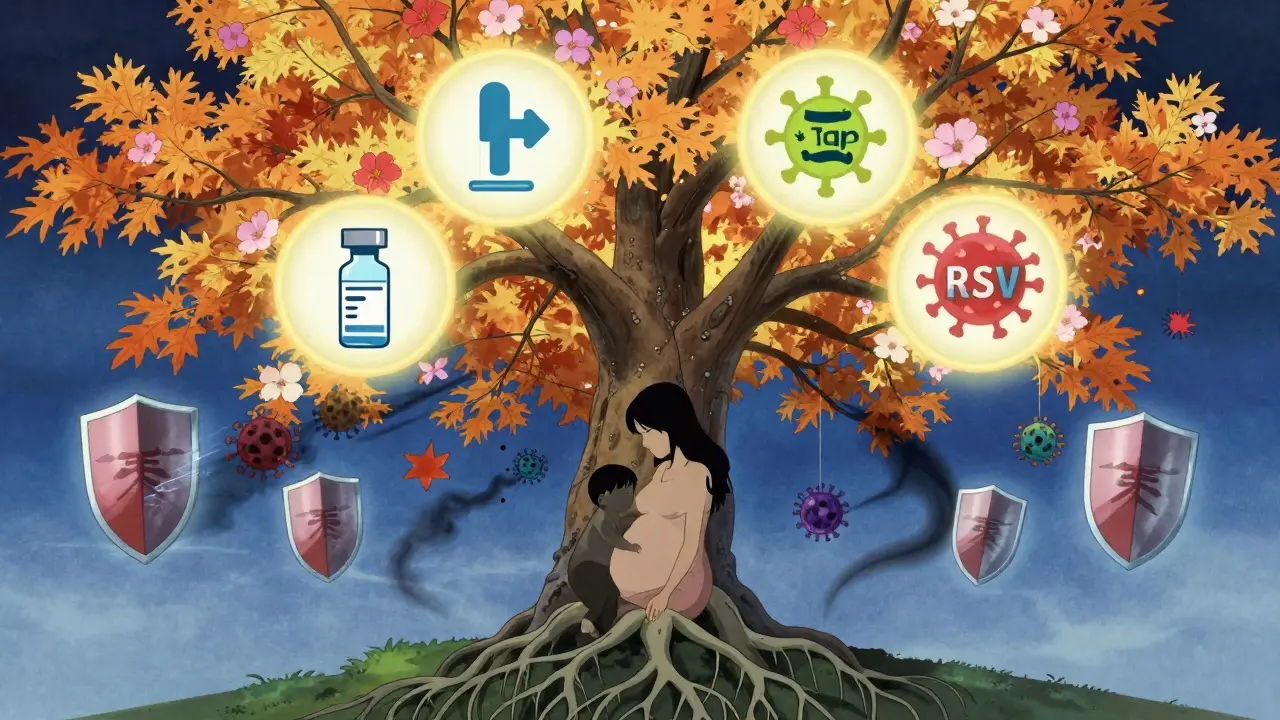
Not all vaccines are safe during pregnancy. Live vaccines - like the nasal flu spray, MMR, or chickenpox shot - are avoided because they contain weakened viruses. But inactivated and mRNA vaccines? They’re not just safe - they’re recommended.
- Influenza (flu) vaccine: Get this every year, no matter what trimester you’re in. The best time? As soon as it’s available, usually in the fall. During the 2020-21 flu season, over 264,000 pregnant people in England got the shot - and it cut their risk of flu-related hospitalization by up to 40%. It also gives your baby protection for the first few months after birth.
- Tdap (tetanus, diphtheria, pertussis): This one has a tight window: between 27 and 36 weeks of pregnancy. Why then? That’s when your body makes the most antibodies to pass along. Getting it earlier than 20 weeks means your baby gets 37% fewer protective antibodies. The goal? To prevent whooping cough - a disease that kills about 20 babies a year in the U.S. alone, mostly under 2 months old.
- COVID-19 mRNA vaccines (Pfizer or Moderna): These are safe at any point during pregnancy. Data from over 139,000 pregnant people shows no increased risk of miscarriage, preterm birth, or birth defects. In fact, during 2021, 96% of pregnant people hospitalized with severe COVID-19 hadn’t been vaccinated. The vaccine cuts your risk of hospitalization by 96%.
- RSV vaccine (Abrysvo): Approved in 2023, this vaccine is given between 32 and 36 weeks during RSV season (September through January). It reduces the chance of your baby needing hospital care for RSV by 82% in the first 90 days after birth. That’s a game-changer - RSV is the top cause of infant hospitalizations in the U.S.
What About Breastfeeding?
If you’re breastfeeding, you’re still a candidate for all the same vaccines. In fact, getting vaccinated while breastfeeding gives your baby extra protection through your milk. Antibodies from the flu, Tdap, and COVID-19 vaccines show up in breastmilk, giving your baby another layer of defense. No vaccine is off-limits while nursing - not even the live ones. You can safely get MMR or chickenpox shots after delivery, even if you’re breastfeeding.

Side Effects? What to Expect
Most side effects are mild and short-lived. The most common? Sore arm. That’s it. Some people report fatigue, headache, or a low-grade fever - but these happen just as often in non-pregnant people. A CDC study tracking 139,897 pregnant people who got the COVID-19 vaccine found that 84.6% had no pregnancy complications linked to the shot. Only 69.8% reported injection site pain - the same rate as the general population.
On Reddit’s pregnancy forums, 87% of respondents said they got Tdap. Most described only mild soreness. On BabyCenter, 92% of people who got the RSV vaccine said they felt fine - just a little tired for a day. The real risk isn’t the vaccine. It’s the disease.
What Vaccines to Avoid
Stay away from live vaccines while pregnant. That includes:
- Nasal flu spray (LAIV)
- MMR (measles, mumps, rubella)
- Varicella (chickenpox)
- Live attenuated shingles vaccine (Zostavax)
If you need any of these, get them at least 28 days before you get pregnant. If you find out you’re pregnant after getting one, don’t panic. No birth defects have been linked to accidental exposure. But do tell your provider - they’ll monitor you closely.
Why So Many People Still Don’t Get Them
Despite the evidence, vaccine hesitancy lingers. A March of Dimes survey found that 41% of pregnant people who skipped vaccines worried about their baby’s safety. That’s understandable - but it’s based on old myths. The data now is overwhelming: over 1.5 million pregnant people have received the flu vaccine since 2010. Over 1.2 million got Tdap. No safety signals. No hidden risks.
Doctors are getting better at talking about it too. Since January 2023, ACOG has required providers to document vaccine counseling in prenatal records. Result? Recommendation rates jumped from 76% to over 93%. When your OB says, “This is for your baby,” people listen.
What’s Next? New Vaccines on the Horizon
The science is moving fast. In September 2023, the FDA approved the first-ever Group B Streptococcus (GBS) vaccine for Phase III trials. GBS causes deadly infections in newborns - and right now, the only prevention is IV antibiotics during labor. A vaccine could change that entirely.
Researchers are also testing a universal flu vaccine that could protect against all strains, not just the few predicted each year. Early results show 85% effectiveness - far better than the current 40-60%. And global efforts aim to get 70% of pregnant people worldwide vaccinated by 2030. Right now, only 15-25% in low-income countries get the basics.
Final Thoughts: Your Baby’s First Shield
You can’t control everything in pregnancy. But you can choose to get these vaccines. They’re not optional extras. They’re essential tools - like prenatal vitamins, but for your baby’s immune system. The data is clear. The timing is precise. The protection is real.
If you’re pregnant right now, ask your provider: “Which vaccines do I need, and when?” Don’t wait. Don’t assume they’ll bring it up. Take charge. Your baby’s first line of defense starts with you.
Is it safe to get the flu shot while pregnant?
Yes. The inactivated flu shot is safe at any stage of pregnancy. It reduces your risk of flu-related hospitalization and passes protective antibodies to your baby, lowering their chance of getting the flu in the first few months after birth. Over 1.5 million pregnant people have received it since 2010 with no safety concerns.
When should I get the Tdap vaccine during pregnancy?
Between 27 and 36 weeks of pregnancy, ideally at 27-30 weeks. This timing ensures your body produces the highest level of pertussis antibodies to pass to your baby. Getting it earlier than 20 weeks reduces antibody transfer by 37%, leaving your newborn more vulnerable to whooping cough.
Can I get the COVID-19 vaccine if I’m pregnant?
Yes. The mRNA vaccines (Pfizer and Moderna) are safe and recommended during pregnancy. Data from over 139,000 pregnant individuals shows no increased risk of miscarriage, preterm birth, or birth defects. Vaccination reduces your risk of severe illness by 96% and helps protect your newborn from COVID-19.
Is the RSV vaccine safe during pregnancy?
Yes. The RSV vaccine (Abrysvo) is recommended between 32 and 36 weeks of pregnancy during September-January. It reduces the risk of your baby being hospitalized for RSV by 82% in the first 90 days after birth. Side effects are mild - mostly fatigue or headache - and last less than two days.
What if I got a live vaccine before I knew I was pregnant?
Don’t panic. There’s no evidence that accidental exposure to live vaccines like MMR or chickenpox causes birth defects. However, you should inform your provider so they can monitor your pregnancy closely. In the future, get live vaccines at least 28 days before trying to conceive.
Can I get vaccinated while breastfeeding?
Yes. All vaccines, including live ones, are safe while breastfeeding. Antibodies from vaccines like flu, Tdap, and COVID-19 pass into breastmilk, giving your baby extra protection. Breastfeeding doesn’t interfere with vaccine effectiveness - and it helps your baby stay healthier.

I got my Tdap at 29 weeks and barely felt a thing. My baby is now 4 months old and hasn’t had a single cold. I swear by this stuff.
If you're pregnant and skipping vaccines because you're scared of needles, you're not protecting your baby-you're just delaying the inevitable. The science isn't optional. Get the shot. Period.
Let me guess-this is another CDC propaganda piece disguised as medical advice. Where's the long-term data? Where are the independent studies? I’ve seen too many babies with autism born to vaccinated mothers to believe this nonsense.
Bro I got the RSV shot last year at 34 weeks and my niece got RSV at 6 weeks and was fine because of the antibodies. Like, it's not magic-it's biology. And honestly? I'd rather be tired for a day than watch my kid gasp for air in the NICU. That’s not fear, that’s foresight.
In India, most pregnant women don't even know these vaccines exist. My sister got Tdap because her nurse mentioned it-no one pushed. We need more outreach, not just data. Real talk: education saves lives, not just needles.
Christine Milne just said vaccines cause autism. Again. The internet is a graveyard of bad takes and she’s the ghost haunting it.
Just got my flu shot yesterday. Sore arm. That’s it. My baby’s got a shield now. 🙌
Tdap at 28 weeks. No fever. No pain. Baby’s protected. Done.
The structural epidemiological integrity of maternal immunization protocols is unequivocally supported by longitudinal cohort analyses spanning over a decade, with effect sizes exceeding 80% for passive neonatal antibody titers. The conflation of anecdotal fear with clinical evidence represents a profound epistemic failure in public health communication. We must recalibrate discourse toward evidence-based praxis, not emotional heuristics.
How delightful that we’ve turned motherhood into a compliance checklist-flu shot, Tdap, RSV, COVID-like a grocery list for the womb. One wonders if the next step will be prenatal vitamin IV drips with a side of CDC-approved optimism. How very… modern. How very sterile. Where is the mystery of nature now? Oh right, it got replaced by a scheduled appointment at CVS.
I come from a village where women never got vaccines. My wife got all four-flu, Tdap, COVID, RSV-and our son is now 6 months old, never sick, never in the clinic. I cried when the nurse said, ‘Your baby’s immune system is already fighting.’ It’s not science fiction. It’s love with a syringe.
You think you’re smart because you got a vaccine? I’ve read the WHO’s 2018 meta-analysis on maternal immunization and the 2022 Lancet paper on RSV antibody decay curves. You’re not a hero-you’re just following the script. Real mothers research. Real mothers question. Real mothers don’t swallow corporate-approved protocols like candy.
My cousin in rural Bangladesh got the flu shot during her pregnancy and her daughter is now 2 and has never had pneumonia. That’s not luck. That’s global science working. We need more of this, not less.
My OB didn’t even mention RSV until I asked. That’s messed up. If they’re not telling you, you gotta push. Your baby’s life isn’t a suggestion.
Let’s be real for a second. The pharmaceutical industry is worth trillions. They didn’t suddenly become saints because a few studies came out. There’s profit in vaccines. There’s always profit. And while we’re celebrating the ‘science,’ we’re ignoring the fact that we’ve been conditioned to trust institutions that have lied before. The flu shot? Maybe. But the RSV vaccine? New. Unproven long-term. And if you’re not asking why it was rushed through approval, you’re not thinking-you’re just obeying.