

SAMS-CI Calculator: Statin Rechallenge Risk Assessment
This tool calculates your risk of successfully tolerating a statin rechallenge based on the SAMS-CI clinical index.
The Statin-Associated Muscle Symptom Clinical Index (SAMS-CI) helps determine if you're likely to tolerate a statin rechallenge after muscle pain. Each 'yes' question adds 1 point to your score.
Answer the 5 questions below
1. Did symptoms start within 6 months of starting the statin?
2. Did symptoms resolve after stopping the statin?
3. Did symptoms return when you restarted the same statin?
4. Are you over 70?
5. Do you have kidney disease or take other muscle-affecting drugs (like fibrates or certain antibiotics)?
Your risk score will appear here after calculation.
Stopping statins because of muscle pain sounds like a smart move-until you realize how much risk you’re taking. Statins cut heart attacks and strokes by up to 30% in high-risk patients. But if you’ve had muscle pain, weakness, or cramps while on them, you’re not alone. About 1 in 4 people stop statins because of muscle symptoms. The problem? Most of those symptoms aren’t even caused by the drug. And skipping statins for good might be more dangerous than staying on them.
What Exactly Is Statin-Induced Myopathy?
Statin-induced myopathy isn’t one thing. It’s a range of muscle issues-from mild aches to full-blown rhabdomyolysis, where muscle tissue breaks down and can damage your kidneys. The most common form is statin-associated muscle symptoms (SAMS): pain, stiffness, or weakness that starts after you begin a statin. But here’s the twist: in clinical trials where people didn’t know if they were taking a statin or a sugar pill, the rate of muscle pain was nearly the same. That suggests a big chunk of what we call "statin myopathy" might be the nocebo effect-your brain expecting pain, so you feel it.
True statin myopathy is rare. Serious cases like rhabdomyolysis (CK levels over 40 times the normal limit) happen in fewer than 1 in 1,000 people. But even mild cases can scare patients off statins for good. And that’s where things get risky. Stopping statins means your LDL cholesterol creeps back up. Plaques in your arteries can become unstable. Within weeks, your heart attack risk starts climbing again.
Why Rechallenge? The High Stakes of Quitting
Let’s say you had muscle pain on atorvastatin 40 mg and stopped cold. Your doctor says, "Let’s try something else." But what if the "something else" is a PCSK9 inhibitor? It works-but it costs $5,850 a month. Generic statins? $4 to $10. If you’re over 65, have diabetes, or had a heart attack before, you’re not just saving money-you’re saving your life.
Studies show that patients who successfully rechallenge statins after muscle symptoms have 28% fewer heart events than those who stay off them entirely. That’s not a small gain. It’s the difference between living and dying. The goal isn’t to force you back on the same pill. It’s to find a way to keep you protected without pain.
The MEDS Approach: A Proven Framework
Cardiologists and lipid specialists use the MEDS strategy to guide rechallenge. It’s simple, practical, and backed by evidence:
- Minimize time off statins: Don’t wait months. If symptoms are gone after 2-4 weeks, it’s time to try again. The longer you’re off, the more your plaque destabilizes.
- Education: Understand what’s real and what’s psychological. Many patients think their pain means "the statin is toxic." But if your CK levels were normal and you felt better off the drug, it’s likely not a true muscle injury.
- Diet and nutraceuticals: Coenzyme Q10 doesn’t fix everything, but some patients report less pain with 100-200 mg daily. Vitamin D deficiency worsens muscle symptoms-check your levels. Red yeast rice contains a natural statin and isn’t safer-it’s unregulated and risky.
- Monitoring: Before restarting, check your CK and thyroid levels. Hypothyroidism mimics statin myopathy. After restarting, check again in 2-4 weeks. Track symptoms daily.
This isn’t guesswork. It’s a protocol. And it works.

Which Statin Should You Try Next?
Not all statins are created equal when it comes to muscle risk. Some are much gentler:
- Pravastatin and fluvastatin are least likely to cause muscle issues. They’re not metabolized by the liver enzyme CYP3A4, which means fewer drug interactions and lower muscle toxicity.
- Pitavastatin is another low-risk option, especially for older adults.
- Avoid simvastatin at high doses (especially 80 mg)-it’s the biggest offender. Even 40 mg can be risky in older people or those with kidney problems.
- Atorvastatin and rosuvastatin are strong but can be tried at low doses (10 mg or less) after a break.
A 2023 survey of patients who rechallenged found that 41% succeeded by switching from simvastatin to pravastatin. Another 29% did well with every-other-day dosing. You don’t need to take a statin daily to get benefit. Studies show every-other-day rosuvastatin 10 mg lowers LDL nearly as well as daily 5 mg.
Use the SAMS-CI: Your Personal Risk Score
There’s a tool called the Statin-Associated Muscle Symptom Clinical Index (SAMS-CI). It’s not fancy, but it’s powerful. It asks five simple questions:
- Did symptoms start within 6 months of starting the statin?
- Did symptoms resolve after stopping the statin?
- Did symptoms return when you restarted the same statin?
- Are you over 70?
- Do you have kidney disease or take other muscle-affecting drugs (like fibrates or certain antibiotics)?
Each "yes" adds a point. A score of 0-2 means you have a 91% chance of tolerating a rechallenge. A score of 4-5? You’re at high risk. This isn’t guesswork-it’s science. Yet only 43% of primary care doctors use it. If your doctor hasn’t mentioned it, ask for it.
When NOT to Rechallenge
There are two situations where you should never try a statin again:
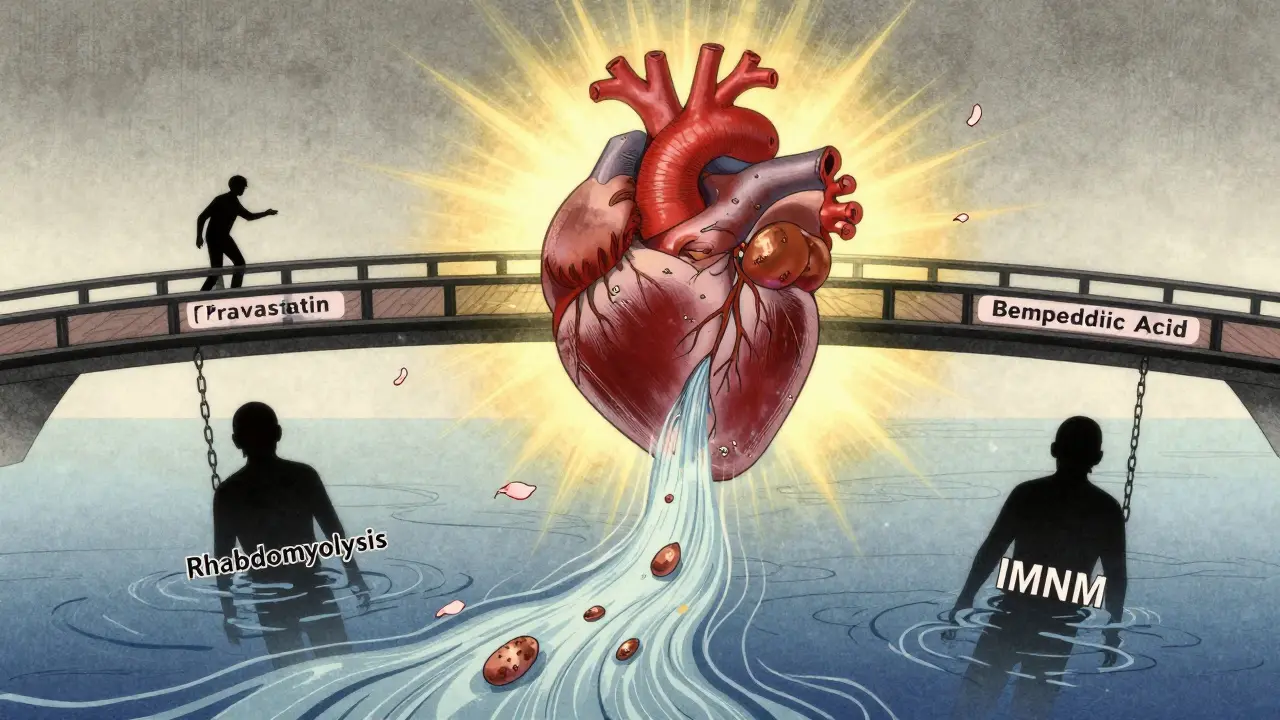
- Immune-mediated necrotizing myopathy (IMNM): If you have anti-HMGCR antibodies, your body is attacking your own muscle tissue because of the statin. This is autoimmune. You need immunosuppressants like prednisone or IVIG-not another statin.
- Rhabdomyolysis: If your CK was over 40x the upper limit, you had muscle breakdown that threatened your kidneys. Even if you recovered, restarting a statin is too dangerous. Go straight to alternatives.
These are rare-less than 1% of statin users-but they’re real. If you had extreme weakness, dark urine, or kidney issues, get tested for HMGCR antibodies before even thinking about rechallenge.
Alternatives When Statins Just Won’t Work
If you’ve tried everything and still can’t tolerate any statin, you’re not out of options. Here’s what works:
- PCSK9 inhibitors (evolocumab, alirocumab): Injected every 2-4 weeks, they lower LDL by 50-60%. They’ve been shown to reduce heart attacks and strokes in high-risk patients. Cost is high, but many insurance plans cover them after statin failure.
- Ezetimibe: A pill that blocks cholesterol absorption. Lowers LDL by 15-20%. Safe, cheap, and often combined with a low-dose statin to reduce the statin dose needed.
- Bempedoic acid: A newer oral drug that works in the liver, like statins, but without entering muscle cells. Lowers LDL by 18-22%. Approved for statin-intolerant patients.
None of these match statins for proven, long-term outcomes-but they’re better than nothing. And for many, they’re a bridge back to something more sustainable.
Real Stories, Real Results
One 72-year-old woman in Adelaide had muscle pain on rosuvastatin 20 mg. She stopped for 6 months. Her LDL jumped to 190. Her doctor used the SAMS-CI-score of 1. They restarted her on fluvastatin 20 mg every other day. Two weeks later, her CK was normal. Three months later, her LDL was 85. She’s been on it for 2 years.
A 58-year-old man tried three statins after simvastatin caused cramps. Nothing worked. He got tested for HMGCR antibodies-negative. He switched to bempedoic acid 180 mg daily. His LDL dropped to 90. No pain. He calls it his "second chance."
But not everyone succeeds. One man on Reddit said he tried six different statins at lowest doses. Still had pain. He’s now on evolocumab. "I hate needles," he wrote. "But I hate heart attacks more."
What to Do Next
If you’ve stopped a statin because of muscle pain:
- Wait 2-4 weeks after symptoms fully disappear.
- Ask your doctor for a CK test and thyroid panel.
- Request the SAMS-CI score.
- Discuss switching to pravastatin, fluvastatin, or pitavastatin at half your original dose.
- Try every-other-day dosing if daily still causes issues.
- Track your symptoms daily in a journal.
- If symptoms return, don’t panic. Talk to a lipid specialist. You’re not alone.
Statin myopathy is rarely a life sentence. Most people can find a way back. It just takes the right plan, the right drug, and the right mindset.
Can I restart a statin after muscle pain went away?
Yes, if your symptoms fully resolved after stopping the statin for 2-4 weeks. Most muscle pain linked to statins is reversible and not permanent. The key is to restart carefully-with a lower dose, a different statin, or an every-other-day schedule-and monitor closely.
Which statin is least likely to cause muscle pain?
Pravastatin and fluvastatin have the lowest risk of muscle side effects. They’re not processed by the same liver enzyme as other statins, which reduces drug interactions and muscle toxicity. Pitavastatin is also a good low-risk option, especially for older adults.
Is every-other-day statin dosing effective?
Yes. Studies show that taking rosuvastatin or atorvastatin every other day lowers LDL nearly as much as daily dosing-while cutting muscle side effects in half. It’s a proven strategy for patients who can’t tolerate daily therapy.
How do I know if my muscle pain is really from statins?
Use the SAMS-CI tool. It’s a 5-question clinical score with 91% accuracy in predicting whether you’ll tolerate a rechallenge. If your pain started right after starting the statin, went away when you stopped, and came back when you restarted, it’s more likely to be real. But if your CK was normal and you feel fine off the drug, it might be the nocebo effect.
What should I do if I had rhabdomyolysis?
Never restart a statin. Rhabdomyolysis is a medical emergency. If you had dark urine, extreme weakness, or kidney damage, you need to avoid all statins. Talk to your doctor about PCSK9 inhibitors or bempedoic acid as safer alternatives.
Are PCSK9 inhibitors worth the cost?
If you truly can’t tolerate any statin and you’re at high risk for heart disease, yes. They reduce heart attacks and strokes by 15-17%. Many insurance plans approve them after you’ve tried and failed at least two statins. Generic statins cost $4-$10 a month; PCSK9 inhibitors cost about $5,850. But your life is worth more than the price tag.


Interesting read. I’ve been off statins for a year after cramps started, but my LDL’s still at 160. Might try fluvastatin every other day like they said.
Statin myopathy is often psychological, but dismissing it outright ignores real suffering. The body remembers.
Oh wow, another medical article that treats patients like broken machines. "Just try another statin!" Meanwhile, my muscles scream like I ran a marathon while on fire. No thanks. I’ll take my 190 LDL and my intact quadriceps, please. 😭
the nocebo effect is real but so is the pain… we’re not just brains in jars 😔
This is one of the most balanced, evidence-based takes I’ve seen on statin intolerance. Too often, patients are either told to "just push through" or abandoned entirely. The MEDS approach is practical, and the SAMS-CI tool deserves far more widespread use. Kudos to the author for emphasizing individualized care over dogma.
Wait… so you’re telling me the pharmaceutical companies didn’t just invent "statin myopathy" to sell us more expensive drugs? That’s what my cousin’s chiropractor said. He’s got a YouTube channel. And he’s never had a heart attack.
USA thinks it owns medicine now? In India we just eat turmeric, squat daily, and pray to Shiva. No pills needed. Your cholesterol is a capitalist illusion. Your statins are just corporate poison wrapped in white coats. 🇮🇳
Man, I tried every statin under the sun. Pain every time. Then I switched to bempedoic acid - no muscle issues, LDL dropped like a rock. I don’t care if it’s expensive. I’m alive and I can climb stairs again. This stuff saved me. 🙌
There’s a difference between fear and harm. The nocebo effect doesn’t make pain imaginary - it just means the trigger isn’t always chemical. Understanding that helps us respond better, not dismiss it.
Oh, so now we’re blaming the patient’s brain for not wanting to turn into a human popsicle because a pill made their legs feel like wet cardboard? Brilliant. Next you’ll tell me my chronic back pain is just a lack of positive vibes. 🤡
every other day dosing… really works? i tried it with atorvastatin… felt fine… but then i forgot to take it for three days… and my leg cramped so bad i cried… i think my body’s confused now
As someone who’s worked with elderly patients in rural clinics, I’ve seen how fear of statins leads to preventable heart attacks. The MEDS framework isn’t just science - it’s compassion with a protocol. Thank you for giving clinicians a clear path to help people without dismissing their experience.