

Most people think sunscreen is just about avoiding sunburn. But if you’re using it wrong, you’re not just risking a red face-you’re leaving your skin vulnerable to skin cancer and premature aging. The truth? Many OTC sunscreens on the shelf today don’t deliver what they promise. Some claim SPF 100 but barely block UVA rays. Others leave a white cast so thick you look like a ghost. And how many of us actually reapply every two hours? Less than 15%, according to real-world studies.
What SPF Really Means (And Why Higher Isn’t Always Better)
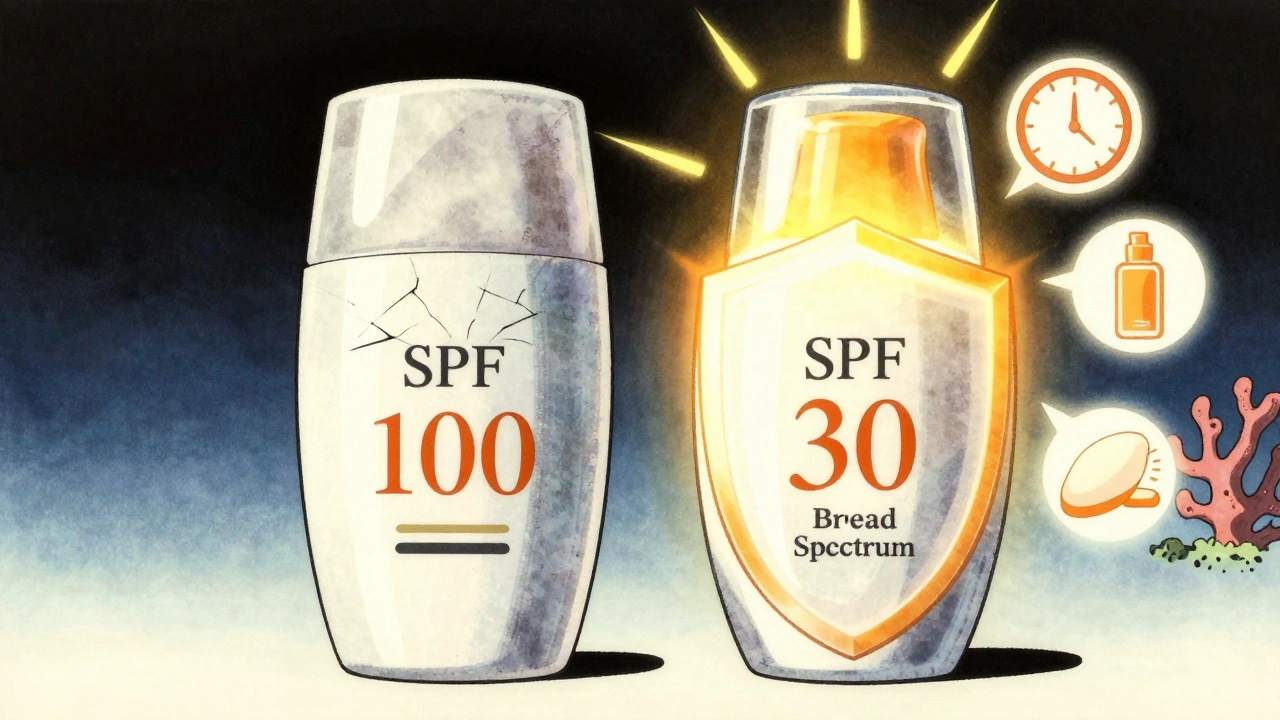
SPF stands for Sun Protection Factor. It measures how well a sunscreen blocks UVB rays-the kind that cause sunburn. SPF 30 blocks about 97% of UVB. SPF 50 blocks 98%. SPF 100? Just 99%. That’s it. The difference between SPF 30 and SPF 100 isn’t double the protection-it’s barely a 2% gain. And here’s the catch: SPF only measures UVB protection. It tells you nothing about UVA rays, which penetrate deeper, cause wrinkles, and contribute to melanoma.
That’s why SPF alone is misleading. A product labeled SPF 80 might still offer weak UVA protection. The FDA requires sunscreens to pass a test called Critical Wavelength to earn the "broad spectrum" label. That means it must block UV rays all the way up to 370 nanometers. Without that label, even SPF 50 is basically useless for long-term skin health.
Real-world testing backs this up. In Consumer Reports’ 2025 analysis of over 100 sunscreens, some SPF 50+ mineral sunscreens performed worse than basic SPF 30 chemical formulas. One brand marketed as SPF 50 delivered only SPF 13 in lab tests. That’s not a typo. That’s fraud.
Broad Spectrum Isn’t a Marketing Buzzword-It’s a Lifesaver
UVA rays don’t burn your skin. They age it. They break down collagen. They trigger DNA damage that leads to skin cancer. And here’s the scary part: you can’t feel them. You won’t get red. You won’t know you’re being damaged until it’s too late.
Only sunscreens labeled "broad spectrum" have been tested to protect against UVA. And the FDA now requires broad-spectrum products to have an SPF of at least 15-though dermatologists agree you should never go below SPF 30. The American Academy of Dermatology says daily use of broad-spectrum SPF 30+ reduces melanoma risk by 50%. That’s not a guess. That’s from decades of clinical data.
But not all broad-spectrum sunscreens are equal. Chemical filters like avobenzone and octocrylene absorb UV rays like a sponge. They’re effective, lightweight, and invisible on skin. Mineral sunscreens-zinc oxide and titanium dioxide-sit on top of your skin and reflect UV like a mirror. They’re great for sensitive skin, but many cheap mineral formulas don’t spread evenly, leaving gaps. That’s why a $5 drugstore mineral sunscreen might give you less protection than a $20 chemical one.
Mineral vs. Chemical: What Actually Works for Your Skin
Mineral sunscreens (zinc oxide, titanium dioxide) are the go-to for eczema, rosacea, and melasma. Zinc oxide has anti-inflammatory properties. That’s why dermatologists like Dr. Michele Green recommend EltaMD UV Clear SPF 46 for acne-prone and sensitive skin. It contains 9% zinc oxide and niacinamide, which helps calm redness.
But here’s the downside: mineral sunscreens often leave a white cast. And if you have darker skin, you’ve probably experienced the chalky, ashy look. That’s not your fault-it’s poor formulation. Some brands, like Black Girl Sunscreen, have improved this, but independent tests show many mineral sunscreens still fail UVA protection tests.
Chemical sunscreens, on the other hand, blend seamlessly. Supergoop! Unseen Sunscreen SPF 40 disappears on skin tones from NC25 to NC45. La Roche-Posay Anthelios Melt-in Milk SPF 60 scored 92/100 in protection tests. But chemical filters like oxybenzone and octinoxate have been linked to coral reef damage. Hawaii banned them in 2021. If you’re swimming in oceans or lakes, choose reef-safe options labeled "oxybenzone-free" and "octinoxate-free."
Bottom line: If you have sensitive skin, go mineral. If you want maximum protection and a flawless finish, go chemical. Just make sure it says "broad spectrum" and has SPF 30 or higher.
Reapplication: The Most Ignored Rule in Sunscreen Use
You applied sunscreen this morning. You’re fine, right? Wrong.
Sunscreen doesn’t last all day. Even "water-resistant" formulas only last 40 or 80 minutes in water. And if you towel off? That’s it-protection is gone. Sweat, rubbing your face, even just sitting in the sun degrades the film over time.
The American Academy of Dermatology says reapply every two hours. That’s non-negotiable. But here’s the reality: only 14% of people at the beach actually do it. Most think SPF 50 means they’re protected for five hours. It doesn’t. SPF 100 doesn’t mean you can stay out all day. It means you’re blocking 99% of UVB-for two hours, then you need to reapply.
Here’s how to make reapplication easier:
- Keep a mini bottle in your bag, car, or desk drawer.
- Use a sunscreen stick for touch-ups on nose, ears, and lips.
- Try powder sunscreens (SPF 30+) for reapplying over makeup.
- Set a phone alarm for every two hours if you’re outside.
And don’t forget: you need to apply enough. Most people use only 25-50% of the recommended amount. For your face and neck, you need about a quarter teaspoon. That’s five pea-sized dots. Rub them in. Don’t skip your ears, neck, and scalp part.
What the FDA Is Doing (And Why It’s Still Not Enough)
The FDA has been trying to update sunscreen rules since 2019. They proposed banning 12 chemical ingredients because there’s not enough safety data. Oxybenzone and octinoxate are still allowed-but only up to 6% concentration. The EU caps oxybenzone at 2.2%. That’s a big difference.
By late 2025, new rules are expected to require all sunscreens to meet stricter UVA testing standards, similar to Europe’s. That’s good news. But here’s the problem: the FDA doesn’t require brands to publish their test results. So you’re trusting a label without proof.
That’s why independent testing matters. Consumer Reports, Skin Cancer Foundation, and dermatologist-led labs are the only ones holding brands accountable. Brands like Neutrogena and La Roche-Posay consistently rank high. Cheaper brands? Not so much. In 2025, Consumer Reports found one mineral sunscreen labeled SPF 30 tested at SPF 4. That’s worse than no sunscreen at all.

How to Pick a Sunscreen That Actually Works
Here’s your simple checklist:
- SPF 30 or higher-never go lower.
- Broad spectrum-non-negotiable.
- Water-resistant (40 or 80 minutes)-if you’ll sweat or swim.
- Mineral if sensitive skin-look for zinc oxide 10%+.
- Chemical if you want no white cast-look for avobenzone, octocrylene, or Mexoryl.
- Reef-safe if swimming in oceans-avoid oxybenzone and octinoxate.
- Check reviews-look for real user feedback on texture and performance, not just star ratings.
Price doesn’t always mean quality. CVS Health SPF 50 spray costs $2.99 and performs decently. JLo Beauty’s SPF 30 moisturizer costs $55 and barely outperforms it. Median price? Around $15 per ounce. You don’t need to spend a fortune. Just spend wisely.
What to Avoid
Don’t use:
- Sunscreen sprays without rubbing them in-most people miss spots.
- Products labeled "sunblock"-that term is banned by the FDA.
- Expired sunscreen-active ingredients break down over time.
- Makeup with SPF only-unless you’re applying a full teaspoon of it, it won’t protect you.
- Products without an active ingredient list-avoid them.
And never assume your car window protects you. UVA rays pass through glass. Daily facial sunscreen is just as important indoors as it is at the beach.
Final Takeaway: Sunscreen Is Medicine, Not Makeup
This isn’t about looking good. It’s about staying alive. Skin cancer is the most common cancer in the U.S. And 90% of visible aging is caused by the sun. Every time you skip sunscreen-or use the wrong one-you’re betting your skin’s future.
Use SPF 30+ broad spectrum. Apply a quarter teaspoon to your face. Reapply every two hours. Don’t wait for a tan. Don’t wait for a burn. Do it every day, rain or shine. That’s the only way to protect what you’ve got.
Is SPF 100 really better than SPF 30?
No. SPF 30 blocks 97% of UVB rays. SPF 50 blocks 98%. SPF 100 blocks 99%. The difference is tiny, and none of them last longer than two hours. Higher SPF gives a false sense of security. What matters more is broad-spectrum coverage and proper reapplication.
Can I rely on makeup with SPF instead of sunscreen?
No. To get the SPF listed on your foundation or powder, you’d need to apply a full teaspoon of product to your face. Most people use a fraction of that. Makeup with SPF offers minimal protection and should never replace a dedicated sunscreen.
Why does my mineral sunscreen leave a white cast?
Mineral sunscreens use zinc oxide or titanium dioxide, which are white powders. Cheaper formulas don’t use micronized particles or tinted bases, so they sit on top of the skin. Look for "tinted" mineral sunscreens or brands like Black Girl Sunscreen or EltaMD that are designed for darker skin tones.
Do I need sunscreen on cloudy days or indoors?
Yes. Up to 80% of UV rays penetrate clouds. UVA rays also pass through windows, causing skin aging even if you’re near a window at home or in the office. Daily facial sunscreen is the best defense against long-term damage.
Are spray sunscreens safe and effective?
They can be, but only if you rub them in thoroughly. Most people spray and walk away, missing spots. The FDA warns that sprays can be inhaled and may not provide even coverage. If you use one, spray generously and rub it in with your hands to ensure full protection.
How do I know if my sunscreen is expired?
Check the expiration date on the bottle. If there’s none, assume it’s good for three years from purchase. If the texture changes-becomes grainy, separates, or smells off-discard it. Expired sunscreen loses its effectiveness and won’t protect you.



just used my makeup with spf today and now my nose is peeling lmao
i swear i thought sunscreen was just for beach days until i got a melanoma scare at 28. now i put it on like i’m brushing my teeth. morning, night, even when it’s raining. my skin’s never looked better but honestly? i’m terrified to ever stop.
so let me get this straight… you’re telling me i’ve been wasting my money on that $50 ‘luxury’ sunscreen because the $12 drugstore one actually has better uva protection? thanks for the trauma, doctor.
the real issue here is the fda’s outdated regulatory framework. chemical filters like avobenzone have photodegradation kinetics that compromise efficacy after 90 minutes of uv exposure-unless stabilized with octocrylene or mexoryl sx. most consumer brands don’t disclose their photostabilization protocols, which is why independent lab testing is non-negotiable. also, zinc oxide particle size matters-nano vs non-nano affects both transparency and uva absorption. if you’re not checking the ingredient list for particle dispersion metrics, you’re just gambling with your dna.
spf 100 is a scam and everyone knows it but brands keep selling it because people are dumb. i use la roche posay anthelios every damn day and i don't care if it costs more than my coffee. my skin is my only body part i can't replace. if you're still using spray sunscreen without rubbing it in you're not protecting yourself you're just making a mess
why are we even talking about this? america makes the best sunscreen. europe’s rules are weak. if you want real protection buy neutrogena or heliocare. also if you’re not reapplying every two hours you’re just wasting your time. i set alarms. i carry a stick. i don’t care what you think. my skin is not your experiment.
As a dermatology nurse in Chicago, I’ve seen more cases of melasma worsened by mineral sunscreens that don’t blend than I’ve seen burns from chemical ones. The white cast isn’t just cosmetic-it’s psychological. Women of color skip sunscreen because they look like they’re wearing face chalk. Brands need to invest in tinted formulations with iron oxides, not just slap a ‘for all skin tones’ label on it. And yes, UVA penetrates glass. I’ve treated patients who developed hyperpigmentation from sitting by their office window for eight hours a day. This isn’t about vanity. It’s about equity in dermatological care.
Thank you for this. I used to think sunscreen was optional until I lost my cousin to melanoma at 34. He was in his 20s, used SPF 50, never reapplied, and thought he was safe because he didn’t burn. The reality is terrifying. I now carry a tiny bottle in my pocket, reapply religiously, and tell everyone I know to do the same. It’s not about looking good. It’s about living long enough to see your kids grow up. And if you’re using makeup with SPF? Please, just use real sunscreen first. Your future self will thank you.